Stamped Patios
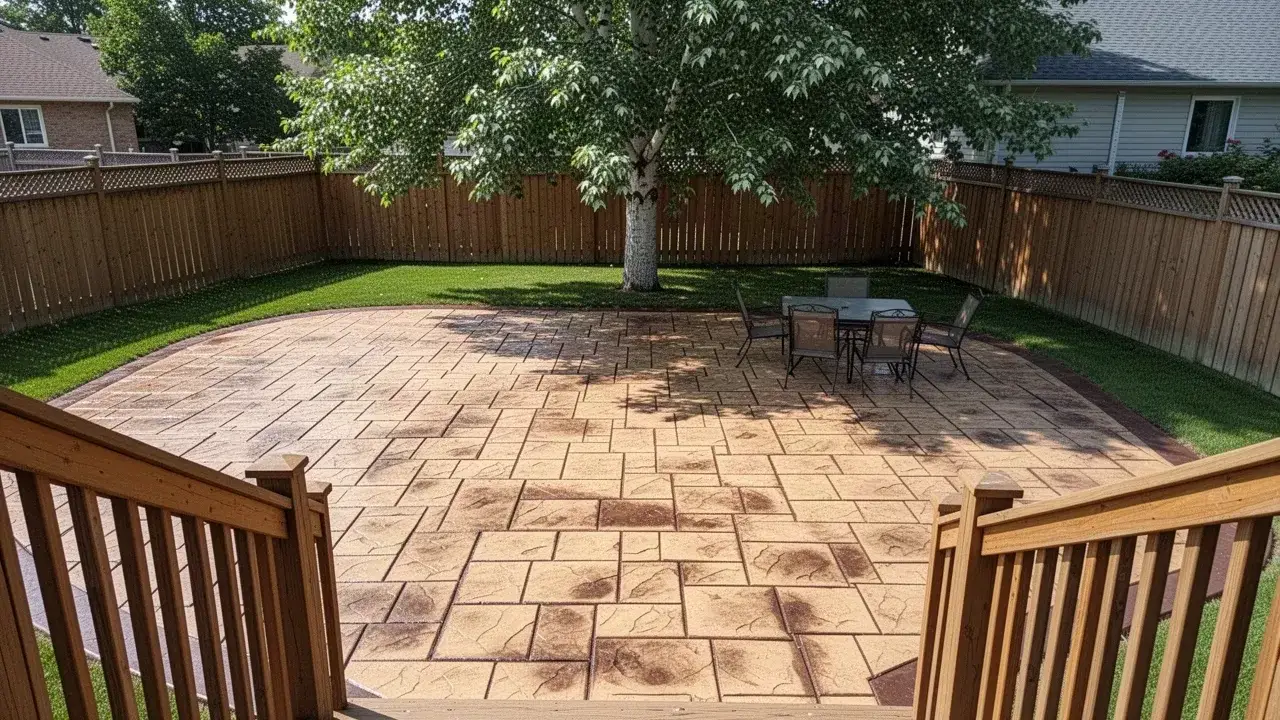
Our most requested decorative job. We often pair a random stone field with a contrasting border; see concrete patios for layout and sizing ideas.
Decorative Concrete
Sila Concrete Contracting installs stamped concrete patios, driveways, walkways and pool decks that look like slate, fieldstone or weathered wood, poured as one continuous slab. You get the character of natural stone for well under the price of laying it, without pavers that settle or joints that sprout weeds.
Stamping is the most unforgiving finish in our trade because the pattern has to go in during a short window while the concrete is still plastic. Over 12+ years and 600+ jobs, our crews have learned how to read that window in July heat and October chill, and how to colour, detail and seal the surface so it still looks right years later.
We work for homeowners across Cambridge and Waterloo Region, and for builders and property managers who want a decorative entrance that stands up to salt and plows.
Stamped concrete suits owners who want a stone or brick look in a single slab that will not shift. These are the projects we stamp most often.
Our most requested decorative job. We often pair a random stone field with a contrasting border; see concrete patios for layout and sizing ideas.
Full stamped surfaces or a stamped border around a broom field. We build the slab to the same spec as our concrete driveways, then add the pattern.
Front paths that tie the driveway to the porch in one pattern. Our concrete walkways page covers widths and slopes.
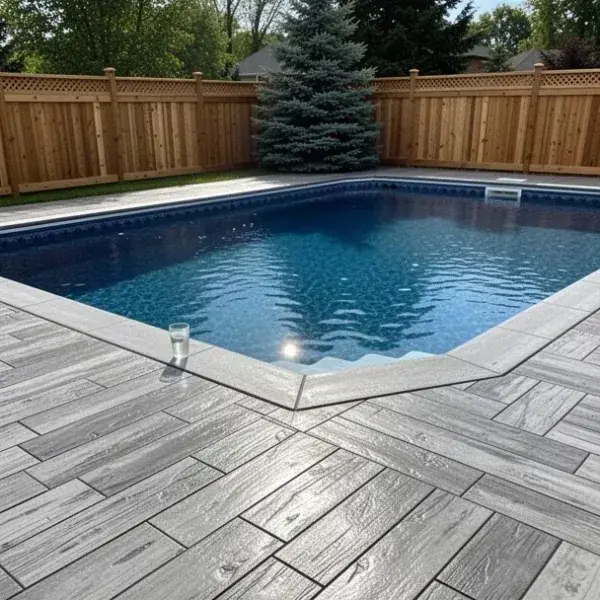
Lightly textured patterns that stay comfortable barefoot, sealed with grit. More on coping and drainage on our concrete pool decks page.
Stamped treads and risers matched to the walkway, with a smooth bullnose edge. See concrete steps and staircases for construction details.
A 300 to 600 mm band of cobble or brick pattern framing plain concrete. It is the most affordable way to add a decorative touch.
Choose the pattern by how the surface will be used, not only by how it looks in a catalogue. Deep grout lines look great on a patio but catch snow shovels and plow blades on a driveway.
| Pattern | What It Looks Like | Best For | Our Notes |
|---|---|---|---|
| Ashlar slate | Rectangular slate pieces in mixed sizes | Patios, driveways, pool decks | Clean, formal look; shallow grout lines shovel well |
| Random stone or flagstone | Irregular natural stone shapes | Patios, walkways | Busy pattern hides hairline cracks and joints best |
| Cobblestone | Rounded cobbles in rows | Driveway borders, aprons | Rough for patio chairs; great as an edge |
| European fan | Arcs of small cobbles | Borders, courtyards | Demanding to lay out; looks stunning done right |
| Wood plank | Boards with grain and nail holes | Pool surrounds, cottage-style patios | Joints must run along board lines |
| Seamless texture skin | Stone texture with no grout lines | Driveways, large areas, pool decks | Easiest to shovel; subtle, natural finish |
Stamp mats come from manufacturers such as Proline, Brickform and Butterfield. We bring sample photos of each pattern in your colour so you can judge scale on your own site.
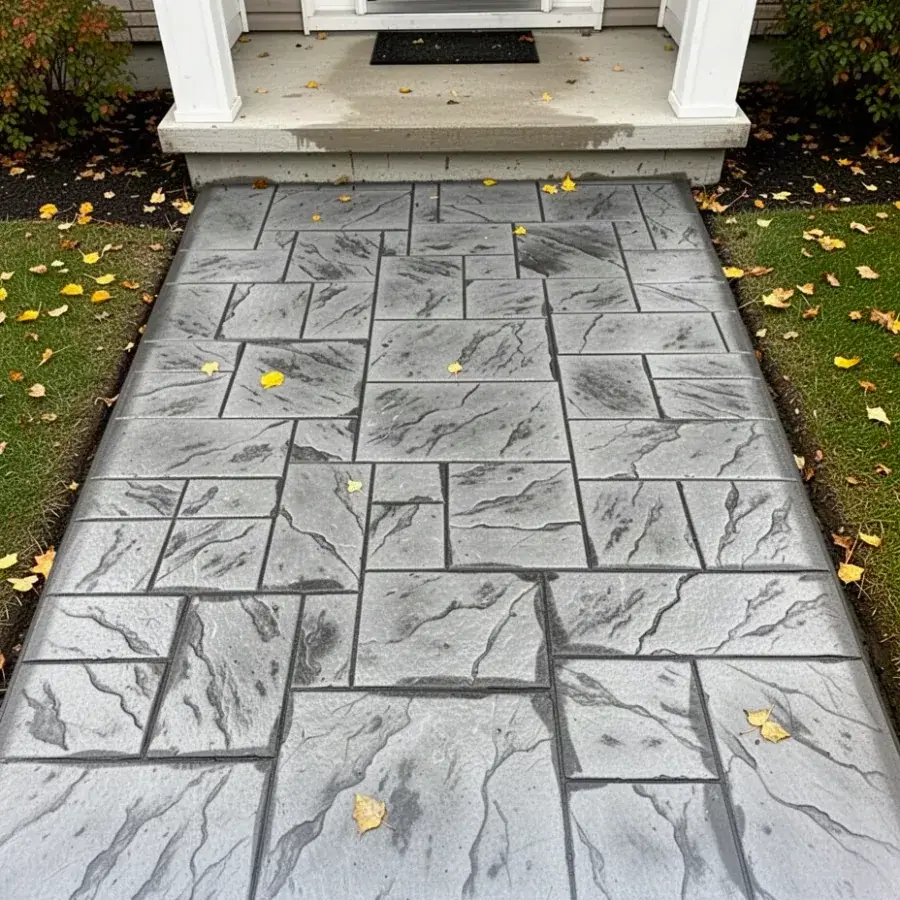
Stamped concrete gets its depth from two colours: a base colour and a darker release that settles into the texture. The base can come from integral pigment mixed at the plant, from dry-shake colour hardener broadcast on the fresh surface, or both.
Colour hardener is our default for stamped work in Ontario. It is a blend of pigment, cement and fine hard aggregate trowelled into the top few millimetres, giving a denser, more vivid and more salt-resistant surface than integral colour alone.
Antiquing release is a coloured powder dusted on before the mats go down so they do not stick. Most washes off, but some stays in the low spots and grout lines, which is what makes the stone look real. Our coloured and stained concrete page goes further into pigments and stains.
Stamped concrete wins on design freedom, exposed aggregate wins on winter grip, and pavers win on spot repairs. Here is how they compare on the points customers ask about most.
| Factor | Stamped Concrete | Exposed Aggregate | Interlock Pavers |
|---|---|---|---|
| Typical installed cost | Mid to high | Mid | High |
| Look | Stone, slate, brick or wood | Natural pebble surface | Real concrete or stone units |
| Maintenance | Reseal every 2 to 3 years | Reseal every 2 to 3 years | Re-sand joints, pull weeds, reset sunken pavers |
| Winter grip | Fair unless sealed with grit | Excellent | Good |
| Repairability | Patches are hard to colour-match | Patches show as a different stone mix | Lift and replace single pavers |
| Settling and weeds | None if the base is right | None if the base is right | Common over time |
If traction matters more than pattern, read about exposed aggregate concrete, which uses real stone at the surface instead of an imprint.
Stamping is a race against the set, so most of the skill is in planning the pour. A 500 sq ft patio typically needs a crew of five to seven on pour day.
We schedule trucks so we never have more concrete on the ground than the crew can stamp. On hot days we pour early and break large areas into sections; on cool days we adjust the mix so we are not waiting until dark.
The 32 MPa air-entrained mix is placed over a compacted Granular A base, screeded flat with the slope built in, and bull floated to close the surface.
Hardener goes on in two passes and is floated and trowelled in until the surface is fully coloured with no grey showing.
Once the surface holds a thumbprint without sticking, we dust on release and lay the mats in sequence, tamping each one evenly. Miss the window and the imprint is shallow; start too early and the mats sink and leave ridges.
Flexible mats and hand texturing tools finish edges against the house, steps and forms where rigid mats will not reach. This is where rushed crews leave smooth, unstamped strips.
We sawcut control joints within the first day and place them along grout lines, so the joint reads as part of the stone layout instead of a straight line through it.
After a few days we pressure wash off the excess release and apply the first coat of sealer once the slab is dry enough.
Send us a photo of the space and a pattern you like, and we will price it with colour options.
Sealer is what keeps stamped concrete looking like stone, and it is also what makes it slippery if it is applied wrong. Here is how we handle both.
We use a breathable, solvent-based acrylic that darkens the colour and protects the release layer. Two thin coats beat one thick one, which traps moisture and peels.
A fine polymer grit such as SharkGrip is mixed into the final coat on pool decks, steps and sloped driveways. It adds bite underfoot without changing the look.
Plan to reseal every 2 to 3 years, or sooner on driveways that see salt. Our concrete sealing service can handle it for you.
Most stamped concrete patios and walkways in Waterloo Region run $18 to $28 per sq ft in 2026, installed. Stamped driveways, which include removal and a thicker slab, typically run $20 to $30 per sq ft.
That works out to roughly $6 to $12 per sq ft more than a plain broom finish on the same slab. The pattern, colours and detailing below are what move a job up or down the range.
| Price Driver | Lower Cost | Higher Cost |
|---|---|---|
| Pattern | Seamless skin or ashlar slate | European fan or wood plank |
| Colours | One base colour, one release | Hardener, integral and hand-applied accent colours |
| Borders | None or one simple band | Contrasting border on every edge |
| Shape | Large rectangles | Curves, tight corners, many edges to hand detail |
| Steps and landings | None | Stamped treads and risers |
| Site | Open access for the truck | Pump or wheelbarrows through a side yard |
Nearly every stamped concrete complaint traces back to timing, sealer or joints. These are the failures we are hired to fix, and how we prevent them on our own work.
Usually integral colour alone with no hardener, or a release layer left unsealed. We use colour hardener and seal promptly so UV and salt cannot wear the antiquing away.
Caused by sealer rolled on too thick, applied to damp concrete, or built up coat after coat. We apply thin coats on a dry slab and strip old sealer before resealing when needed.
Moisture trapped under or in the sealer turns it milky. It often reverses by re-wetting the sealer with a solvent such as xylene, and we avoid it by never sealing before rain or on a cool, damp evening.
Joints spaced too far apart, cut too shallow or cut too late. We keep panels close to square, cut to a quarter of the slab depth, and hide the cuts in grout lines.
A crew too small for the pour stamps late, overlaps mats and leaves plastic ridges. We size the crew to the area, not the other way round.
Glossy sealer with no grit is slick when wet or frosty. We add grit wherever people walk on a slope or around water.
We stamp patios and driveways for clients in Galt, Preston and Hespeler, and for stamped concrete projects in Cambridge of every size. North of the 401, we regularly work as a concrete contractor in Kitchener and a stamped concrete installer in Waterloo, where pool decks and backyard patios lead the requests.
Along the Speed River we are a decorative concrete contractor in Guelph, and out west we pour for country properties as a concrete contractor in Wilmot Township around New Hamburg and Baden.
To the south, we take on stamped concrete work in Brantford as well, all within about 45 minutes of Cambridge.
It can be, if it is sealed with a glossy acrylic and no grit. We mix a fine anti-slip grit into the final coat on driveways, steps and walkways, and recommend sand rather than rock salt for traction in the first winter.
Every 2 to 3 years for most patios, and closer to every 2 years on driveways that see salt and tires. It is due when water stops beading, the colour looks dull and chalky, or the surface turns grey in traffic lanes.
Only with a stamped overlay, and only if the slab underneath is sound. A thin polymer-modified overlay can be textured and coloured like new stamped work; our concrete resurfacing page explains when an overlay is a good fit.
Expect roughly $6 to $12 more per sq ft than a broom finish, or about 40 to 70% more overall. Simple seamless textures sit at the low end, while multi-colour fan or plank patterns with borders sit at the top.
Like all concrete it shrinks as it cures, so we cut control joints to decide where cracks form and hide them in the pattern. Random cracks usually point to poor joint spacing or a weak base, both of which our spec sheet addresses.
Send photos of the space and any pattern or colour ideas you have saved, and we will reply with a written quote listing pattern, colours, sealer and joint layout.