Patios and Walkways
Light mesh or fibre in concrete patios and concrete walkways, where it keeps panels flush across frost-season cracks.
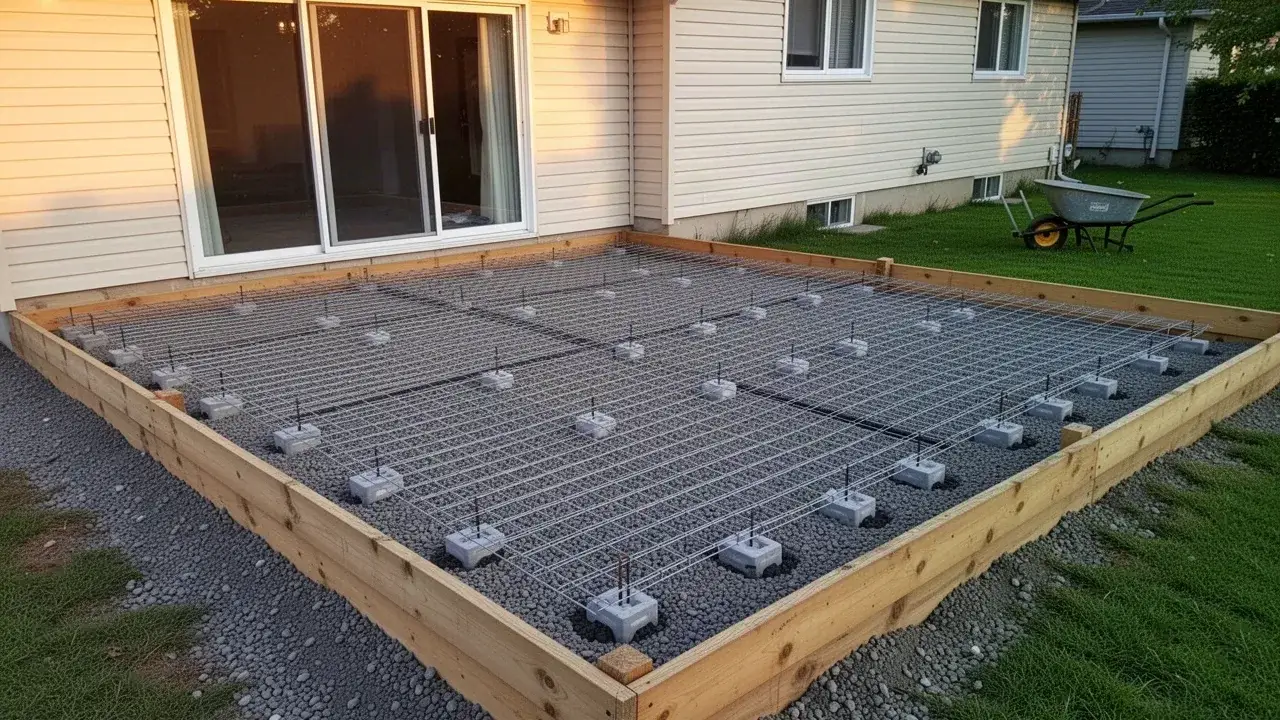
Flatwork Reinforcement
Sila Concrete Contracting installs welded wire mesh reinforcement in patios, walkways, shed and hot tub pads, garage floors and basement slabs across Cambridge and Waterloo Region. Welded wire mesh is a grid of steel wires welded at every crossing, laid inside flatwork to hold shrinkage and frost cracks tight.
Mesh only works when it sits inside the slab, roughly in the upper half of the thickness. Plenty of crews lay it on the gravel and pour over it, which leaves the steel doing nothing at the bottom, so we set flat sheets on chairs and photograph them before the truck arrives.
With 12+ years in flatwork and 600+ jobs completed, we also know when mesh is the wrong choice and rebar or fibre would serve you better. We are licensed, insured and WSIB covered.
We install mesh as part of every slab we pour where it adds value, and we will tell you when it does not.
Light mesh or fibre in concrete patios and concrete walkways, where it keeps panels flush across frost-season cracks.
Heavier sheets for pads that carry concentrated weight; a filled hot tub can exceed 2,000 kg on a small footprint. See our concrete slabs and pads service.
Mesh in concrete garage floors and basement slabs to hold shrinkage cracks tight under vehicles and finished flooring.
We use flat sheets, because rolled mesh keeps its curl and springs back to the bottom of the slab as soon as it is walked on.
Macro synthetic fibre mixed at the plant, for thin or hard-to-access slabs where mesh placement would be unreliable.
Wire mesh does not prevent concrete from cracking. Every slab shrinks as it dries and moves with frost, and the job of choosing where it cracks belongs to properly spaced concrete expansion joints and control joints.
What mesh does is hold any random crack tight so it stays a hairline instead of opening into a gap. It also keeps the two sides at the same height, so a crack does not become a trip edge after a few freeze-thaw cycles.
Mesh cannot make up for a soft base or a thin slab. A 100 mm patio on 150 mm of compacted Granular A with mesh will outlast a mesh-reinforced slab poured over loose fill every time.
Each reinforcement type solves a different problem. For spans, retaining walls and heavy loads, see our rebar reinforcement service instead.
| Factor | Welded wire mesh | Rebar grid | Macro synthetic fibre |
|---|---|---|---|
| Typical added cost | $0.90 to $1.75 per sq ft installed | $1.50 to $3.50 per sq ft installed | $0.60 to $1.20 per sq ft in the mix |
| Crack control | Good when placed correctly | Very good | Good for shrinkage, fair for wide cracks |
| Structural value | Low; holds cracks tight | High; carries tension and spans | Low; spread through the slab |
| Placement risk | High if not chaired | Moderate; bars are stiffer | None; mixed at the plant |
| Best use | Patios, pads, basement and garage floors | Driveways under heavy loads, porches, aprons | Thin slabs, tight access, decorative work |
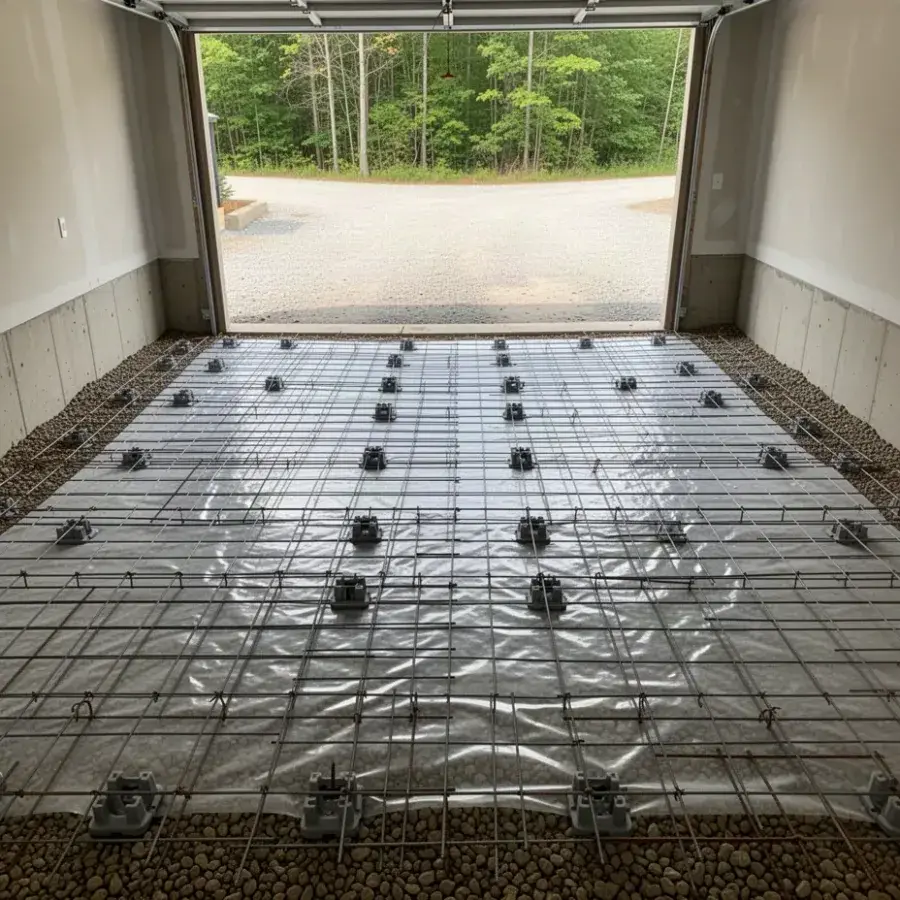
Mesh sinks to the bottom when it is laid flat on the gravel and the crew plans to pull it up with a rake hook during the pour. In practice, workers stand on the very sheets they are lifting, and most of the steel stays on the base.
Our fix is simple: flat sheets on 50 to 65 mm plastic chairs spaced about every 900 mm, sheets lapped by at least one full square and tied, and edges held about 50 mm back from the forms. Walk boards keep feet off the mesh while concrete goes in.
Before the truck is called, we send you photos showing the chairs and a tape measure at the mesh height. If a contractor cannot show you that, assume the mesh is lying in the gravel.
Ask us for a written reinforcement spec with your quote, and placement photos before your pour.
Welded wire mesh is described by wire spacing and wire size. In Canada you will see both the imperial W designation and the metric MW designation, which gives the wire's cross-sectional area in square millimetres.
| Imperial designation | Metric designation | Wire diameter | Typical use |
|---|---|---|---|
| 6x6 W1.4/W1.4 (10 gauge) | 152x152 MW9.1/MW9.1 | About 3.4 mm | Light walkways and landscape pads |
| 6x6 W2.9/W2.9 (6 gauge) | 152x152 MW18.7/MW18.7 | About 4.9 mm | Patios, basement and garage floors, shed pads |
| 6x6 W4.0/W4.0 (4 gauge) | 152x152 MW25.8/MW25.8 | About 5.7 mm | Hot tub pads and slabs under heavier loads |
| 4x4 W2.9/W2.9 | 102x102 MW18.7/MW18.7 | About 4.9 mm | Tighter crack control in thicker slabs |
The light 10 gauge sheets sold at most retailers are too thin to stay flat on chairs, which is why we default to 6x6 W2.9 for patios and floors.
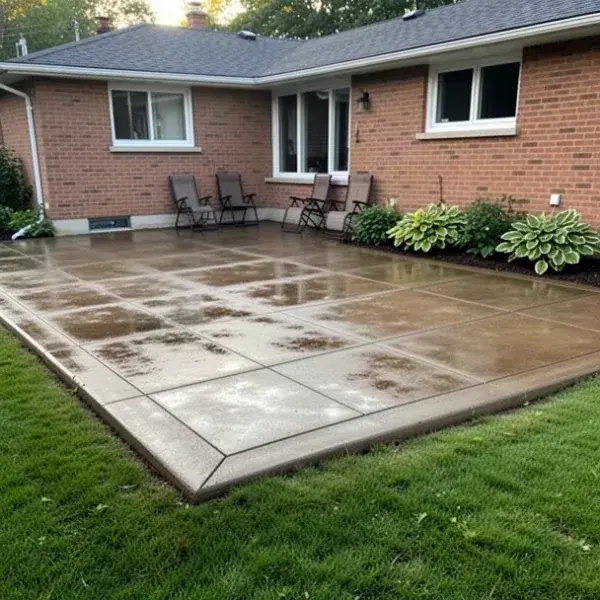
Mesh is one part of a crack control system, and it only works alongside the other two. Control joints are tooled or saw cut to about a quarter of the slab depth, spaced no more than 24 to 30 times the slab thickness, so roughly every 2.4 to 3 m on a 100 mm patio.
Under the slab, a compacted Granular A base gives uniform support, so the concrete does not crack over soft spots. Some engineers also call for cutting every other mesh wire at control joints so the joint can open cleanly.
On garage and basement floors we add a vapour barrier under the slab where required, with chairs that will not puncture it.
Supplied and installed 6x6 W2.9 mesh on chairs typically adds $0.90 to $1.75 per square foot to a slab in Waterloo Region in 2026. On a 300 sq ft patio, that is usually $270 to $525.
Larger slabs spread delivery and set-up over more square footage, lowering the per-foot price.
Heavier W4.0 sheets and 4x4 spacing cost more per sheet and take longer to cut around curves.
Chair height, spacing and type, including vapour-barrier-safe bases, add a small but real cost.
Carrying sheets through a narrow side yard or cutting around drains, posts and curves adds time.
Placing mesh adds an hour or two to a typical patio or pad prep and is done the same day as the pour or the day before. Our written workmanship warranty covers the slab we pour, including reinforcement placed to the agreed spec.
We pour mesh-reinforced slabs within about 45 minutes of Cambridge.
It is not required by code, but we recommend mesh or macro fibre in most patios. Waterloo Region freeze-thaw cycles will crack a slab somewhere, and reinforcement keeps those cracks tight and level instead of open and uneven.
Macro synthetic fibres, longer and thicker strands such as Euclid Tuf-Strand SF or Sika Fiber, can replace light mesh in many slabs when dosed to the maker's rate. Micro fibres are much finer and only reduce early plastic shrinkage cracking, so they are not a substitute for mesh.
Ask for photos before the pour showing chairs under the mesh and a tape measure at its height. We send those photos to every client as standard.
No. Mesh should sit roughly in the middle to upper third of the slab, about 40 to 50 mm below the surface in a 100 mm slab, where it can hold shrinkage cracks tight.
For a normal car driveway on a good base, properly chaired mesh or fibre is usually enough. Heavy vehicles, trailers or weak soils call for a rebar grid.
At least 100 mm, so the mesh can sit with enough concrete above and below it. For thinner pours such as toppings and bonded overlays, fibre is the better reinforcement because there is no room to chair a sheet.
Tell us what you are pouring and we will send a written quote that spells out slab thickness, base depth and reinforcement. Explore our concrete slabs and pads, concrete patios and rebar reinforcement services for the full picture.