Barrier and Mountable Curbs
Barrier curb has a near-vertical face that stops vehicles at drive aisles and building fronts. Mountable curb has a rolled face that cars can cross, which is why subdivisions and condo laneways use it.
Commercial and Residential
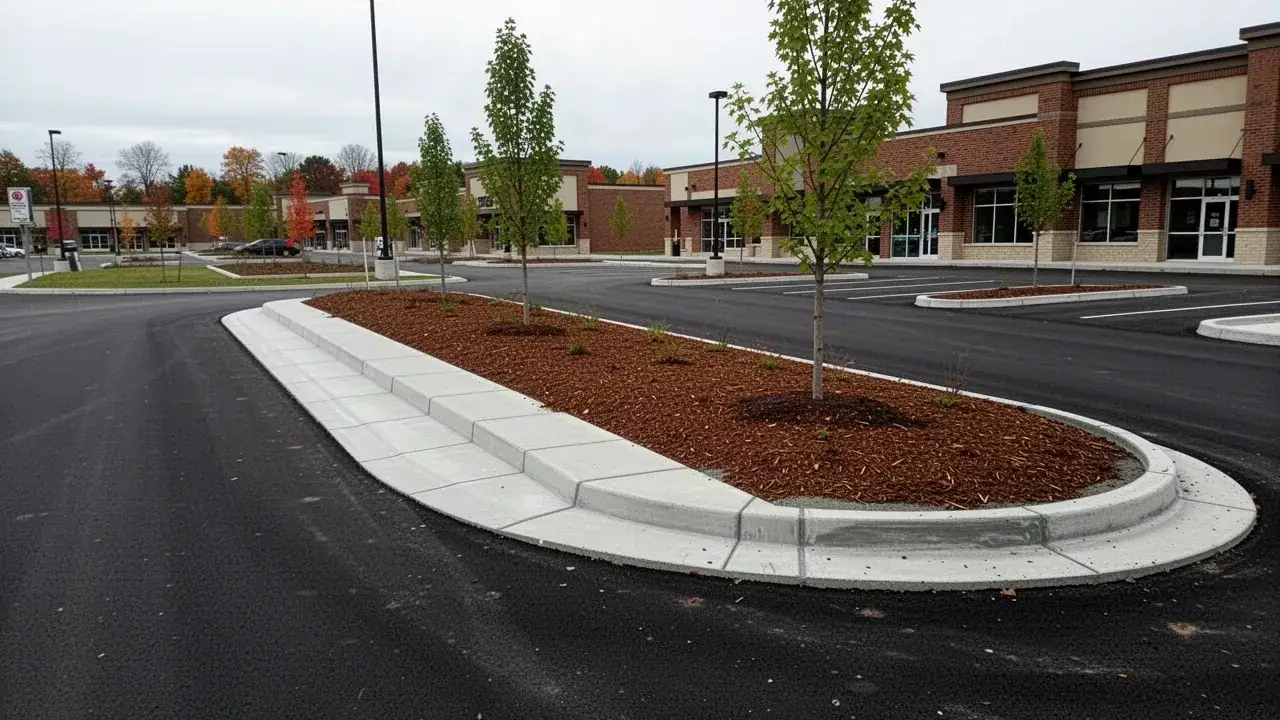
Sila Concrete Contracting builds concrete curbs and edging for two very different clients across Cambridge and Waterloo Region. Property managers and general contractors call us for barrier curb, curb and gutter and parking lot islands that steer traffic and carry stormwater. Homeowners call us for clean, permanent edges around gardens, lawns and driveways.
Both jobs come down to the same discipline: a compacted base, the right profile set to grade, and air-entrained concrete that survives road salt and plough blades. We slipform long commercial runs and hand-form radii, patches and decorative borders where a machine cannot reach.
With 12+ years in the trade and 600+ jobs completed, our crews are licensed, insured and WSIB covered, so your site, your tenants and your lawn are protected while we work.
We handle new curb, replacement and repair on commercial sites, condominium roads and residential properties. Every profile below is formed with 32 MPa air-entrained concrete over a compacted Granular A base.
Barrier curb has a near-vertical face that stops vehicles at drive aisles and building fronts. Mountable curb has a rolled face that cars can cross, which is why subdivisions and condo laneways use it.
A gutter pan cast in one piece with the curb collects runoff and carries it to catch basins. We set the gutter line to the drainage design so water never ponds against the curb face.
Landscaped and painted islands guide traffic, protect light standards and break up large paved areas. Island noses get hand-formed radii and extra reinforcing where trucks turn tight.
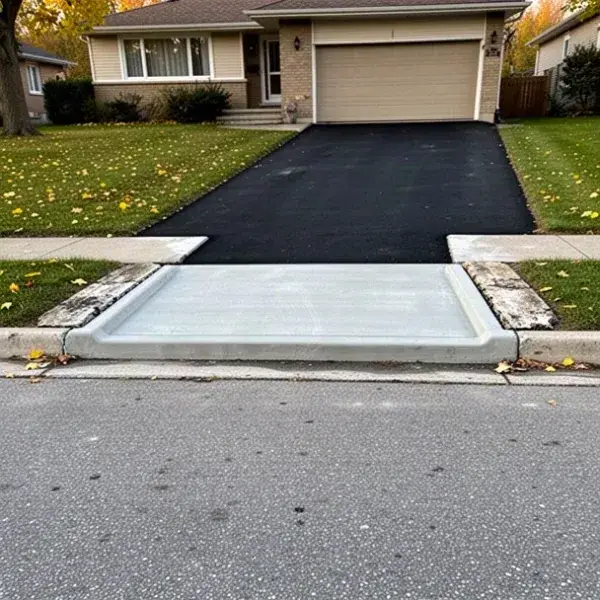
We drop the curb at driveway entrances, loading areas and pedestrian crossings. Pedestrian drops get tactile walking surface indicators where the AODA requires them.
Plough strikes, salt scaling and settled sections are cut out at the nearest joints and recast to match. Targeted repairs keep a lot looking maintained without paying for a full replacement.
Continuous extruded borders hold mulch, river stone and soil where they belong. A flat mower lip lets you trim the lawn edge in one pass.
A concrete border frames asphalt or interlock drives and stops their edges from crumbling. It also pairs well with new concrete driveways as a contrasting band.
Municipal and commercial curb in Ontario is usually specified from the OPSD 600 series of standard drawings and built to OPSS 353, the provincial curb and gutter specification. The City of Cambridge and the Region of Waterloo publish their own drawings for work in the road allowance, and we build to whichever detail your site plan names.
| Curb type | Where it is used | Typical profile | Standard to follow |
|---|---|---|---|
| Barrier curb | Drive aisles, building fronts, island perimeters | Near-vertical face, about 150 mm reveal above the pavement | OPSD 600 series or the site plan detail |
| Mountable curb | Subdivision roads, condo laneways, fire routes | Sloped or rolled face that vehicles can cross | OPSD 600 series or the municipal drawing |
| Curb and gutter | Public roads and private lots that drain to catch basins | Barrier or mountable face cast with a gutter pan | OPSD 600 series and OPSS 353 |
| Island curb | Parking islands, medians, light standard bases | Barrier faces on both sides with radiused noses | Site plan detail from the civil engineer |
| Depressed curb | Driveway entrances, curb ramps, loading areas | Face dropped close to pavement level | City or Region drawing, plus AODA rules at pedestrian crossings |
When no drawing exists, as on many small private lots, we propose a profile in writing before forming so the owner signs off on reveal height and gutter width.
Slipforming is faster and more uniform on long, open runs, while hand-forming wins on tight radii, short sections and patch work. Most commercial sites end up using both.
A slipform curber, such as the Power Curbers and GOMACO units common on Ontario sites, extrudes stiff, low-slump concrete through a steel mould while following a surveyed stringline. On an open run a crew can place a few hundred metres in a day with an identical profile from end to end.
Steel or plywood forms are set and braced by hand, then the concrete is placed, vibrated and tooled. It is slower, but it handles island noses, catch basin transitions and repairs that a machine cannot turn into.
Slipform pricing per metre drops sharply as run length grows, so a full parking lot perimeter usually favours the machine. A 20 metre repair beside a loading door almost never does.
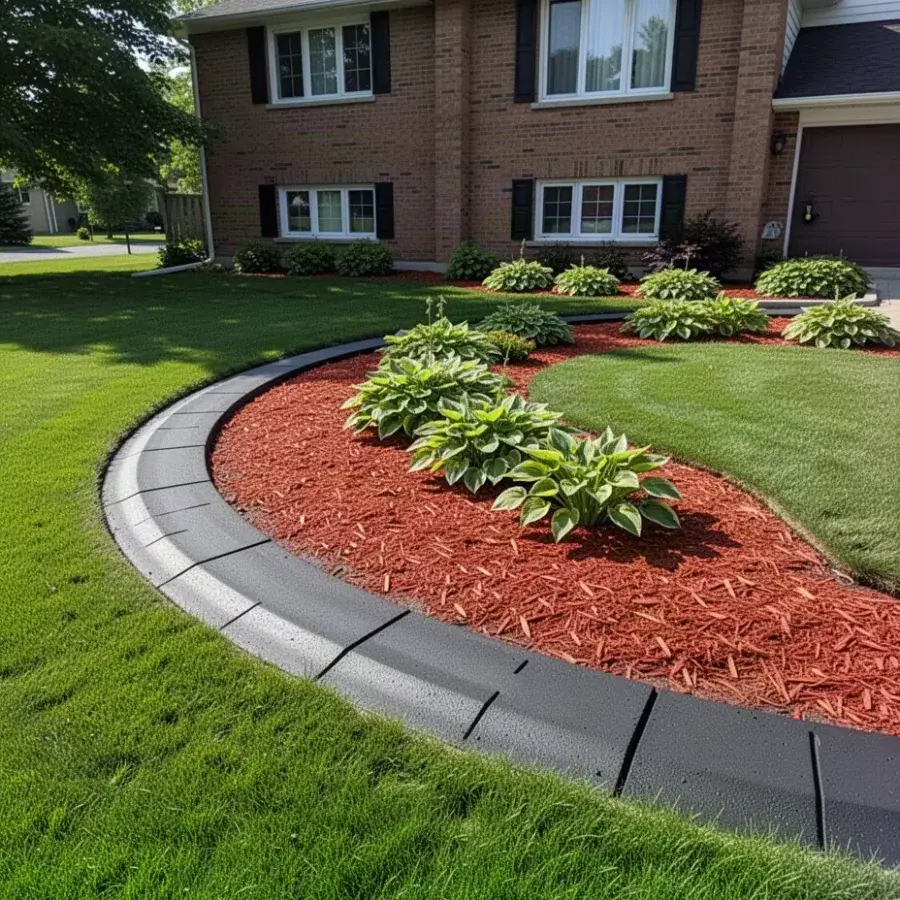
Concrete landscape curbing is a continuous border extruded in place, so there are no seams for grass to creep through and no plastic edge to heave out each spring. It keeps mulch, river rock and soil inside the bed and gives the yard a finished outline.
Common profiles include a mower edge with a flat lip for the trimmer wheel, a slant curb with an angled face, and a squared block curb for a more formal look. Each one follows smooth curves around trees and beds rather than the straight segments that pavers force.
For colour, we add integral pigment to the mix or stamp a slate or brick texture into the top, the same techniques behind our coloured and stained concrete and stamped concrete. Control cuts every 0.6 to 1 metre let the border crack where we plan, not across a curve.
Send the civil drawings or a few site photos and we will return a written curbing quote priced per linear metre.
Most curb we replace in Waterloo Region fails from salt, ploughs or settlement. Chloride-laden meltwater soaks into poorly air-entrained concrete and the surface scales away, while plough blades catch raised joints and snap off the top edge.
We saw-cut the damaged section back to sound concrete, drill and epoxy dowels into the remaining curb where alignment matters, and recast to the original profile. Removal and disposal follow the same approach as our concrete demolition and removal service.
Cutting a new driveway entrance or widening an existing one means altering a boulevard curb, and in Cambridge that needs City approval before anyone touches the concrete. We prepare the curb cut sketch, book utility locates through Ontario One Call, and schedule the work once approval is issued.
We set offset stakes and a tight stringline from the site plan or survey, marking top-of-curb and gutter elevations. Getting grade right here is what makes water reach the catch basins later.
The trench is excavated, soft spots are dug out, and about 150 mm of Granular A is placed and compacted under the curb. Base that settles is the most common reason a curb drops out of line within a few winters.
On long runs the slipform machine follows the stringline, and elsewhere we set steel forms and flexible radius forms. Reinforcing goes in at island noses, dowelled transitions and anywhere the drawing calls for it.
We place 32 MPa air-entrained concrete with 5 to 8% air, vibrate it to remove voids, and finish the face with edging tools and a light broom on the gutter. Landscape edging takes its profile from the extruder shoe, with hand finishing on curves.
Contraction joints are tooled or saw-cut at regular spacing, roughly every 3 metres on commercial curb. Isolation joints go wherever curb meets catch basins, poles, buildings or existing concrete, the same principle behind our concrete expansion joint work.
A curing compound is sprayed on right after finishing to hold moisture in the surface. Once the concrete has set we strip forms and backfill behind the curb so it is supported and protected from undermining.
Most failing curb we are called to fix was doomed on the day it was poured. These are the shortcuts we refuse to take.
Most commercial concrete curb in Waterloo Region costs $90 to $160 per linear metre when slipformed on runs of 100 metres or more, and $150 to $260 per linear metre when hand-formed. Residential landscape edging usually runs $30 to $60 per linear metre, with a minimum charge on small jobs.
| Curb work | Typical 2026 range |
|---|---|
| Slipformed barrier curb or curb and gutter, long runs | $90 to $160 per linear metre |
| Hand-formed curb, islands and short runs | $150 to $260 per linear metre |
| Remove and replace damaged curb sections | $180 to $320 per linear metre |
| Depressed curb at a driveway entrance | $900 to $2,500 per entrance, plus City fees |
| Residential landscape edging, plain grey | $30 to $45 per linear metre |
| Coloured or stamped landscape edging | $40 to $60 per linear metre |
Price moves with run length, profile size, the number of radii, removal of old curb, base repairs, truck access, and whether traffic control or night work is needed. Every quote lists these lines separately and includes a written workmanship warranty covering profile, alignment and finish defects.
We build curb and edging for plazas, industrial properties, condominiums and homes throughout our service area, and travel up to 45 minutes from Cambridge.
Our main market, from plaza islands along Hespeler Road to boulevard curb cuts in Galt, Preston and Hespeler.
Curb and gutter for industrial sites and multi-residential properties close to our Kitchener home base.
Condominium laneway curbs, plaza islands and garden edging for Waterloo homeowners.
Parking lot curbs and island repairs for commercial and industrial owners in Guelph.
Driveway borders and landscape curbing for homes in New Hamburg, Baden and Petersburg.
Curb replacement and new islands for industrial and retail sites in Brantford.
Yes, if the curb sits on the City boulevard or road allowance. In Cambridge, altering a boulevard curb or creating a new driveway entrance needs City approval before work starts, and curbs on Regional roads need a Region of Waterloo permit. Curb on your own private lot, such as a plaza island or garden border, does not need that approval, although site plan conditions may still apply.
Well-built concrete landscape edging commonly lasts 25 years or more, while plastic edging often heaves or splits within 5 to 10 frost seasons. Resealing coloured edging every few years helps it hold its tone.
Usually, yes. We measure the existing reveal, face batter and gutter width, then build a matching form or adjust the slipform mould so the new section lines up. New concrete looks lighter at first and weathers closer to the old curb over a season or two.
For most owners, yes. Extruded asphalt curb is cheaper to install but crumbles and gets knocked loose by ploughs, while concrete curb holds its shape for decades.
Curb season in Waterloo Region runs roughly from April to November. Late-fall pours are possible with insulated blankets, but new concrete needs time to gain strength before its first salt exposure.
Tell us the linear metres, the profile and when the site needs to reopen, and we will send a written quote. Curbing often goes in alongside concrete parking lots and concrete sidewalks and pathways, and you can see the full range of our commercial concrete services.