Driveway Lifting
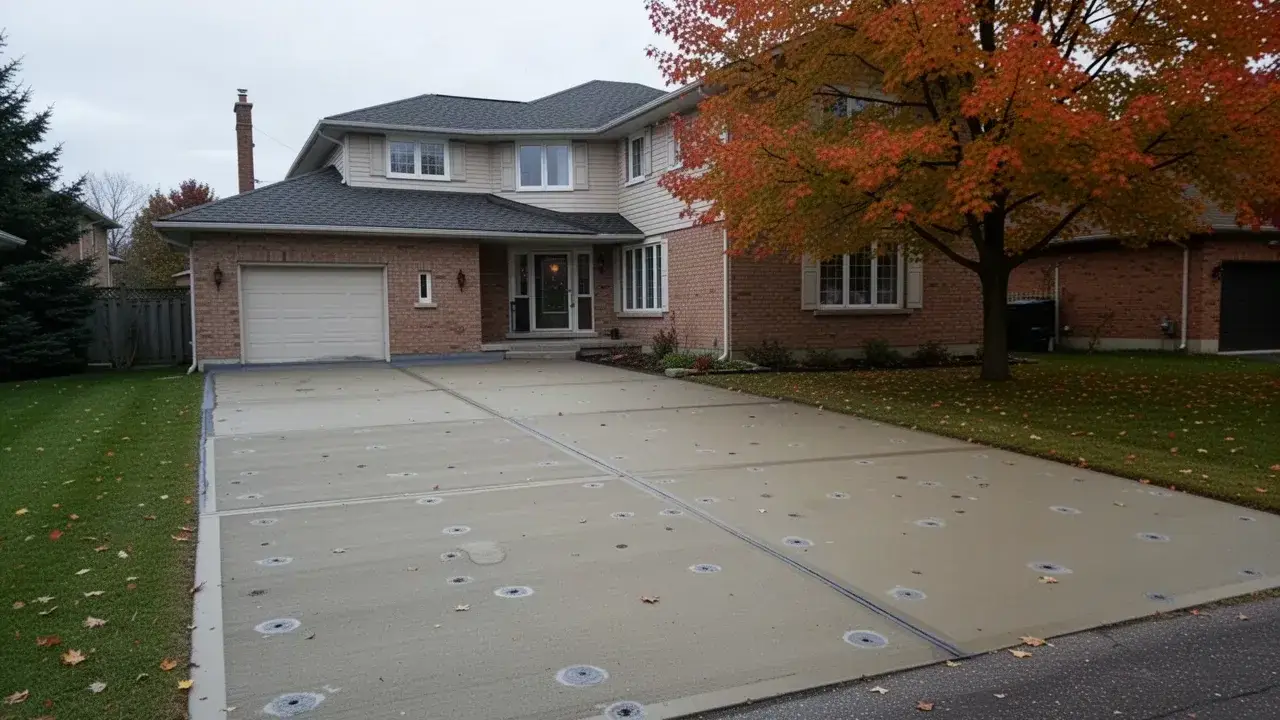
Driveway panels that drop at the garage apron or the city sidewalk leave a lip that catches snow blades and tires. We raise each panel back to plane and restore the slope away from the house.
Slab Lifting, Cambridge
Sila Concrete Contracting raises and stabilizes sunken concrete across Cambridge and Waterloo Region, usually in a few hours and for a fraction of what tear-out and replacement would cost. We lift driveways, walkways, porch steps, patios, pool decks and garage floors by filling the voids that let them drop.
Homeowners call us about trip hazards and rain running back toward the foundation. Property managers call about uneven sidewalk panels at building entrances. Over 12+ years and more than 600 concrete jobs, we have learned that the lift is the easy part; finding out why the soil moved is what keeps a slab level.
Our crews are licensed, insured and WSIB covered. Every lifting job ends with the injection holes patched and the joints sealed, so runoff stops washing out the base that we just filled.
We level exterior and interior concrete for houses, townhomes and commercial sites. If a slab has dropped but is still in one or two solid pieces, it can usually be lifted instead of replaced.
Driveway panels that drop at the garage apron or the city sidewalk leave a lip that catches snow blades and tires. We raise each panel back to plane and restore the slope away from the house.
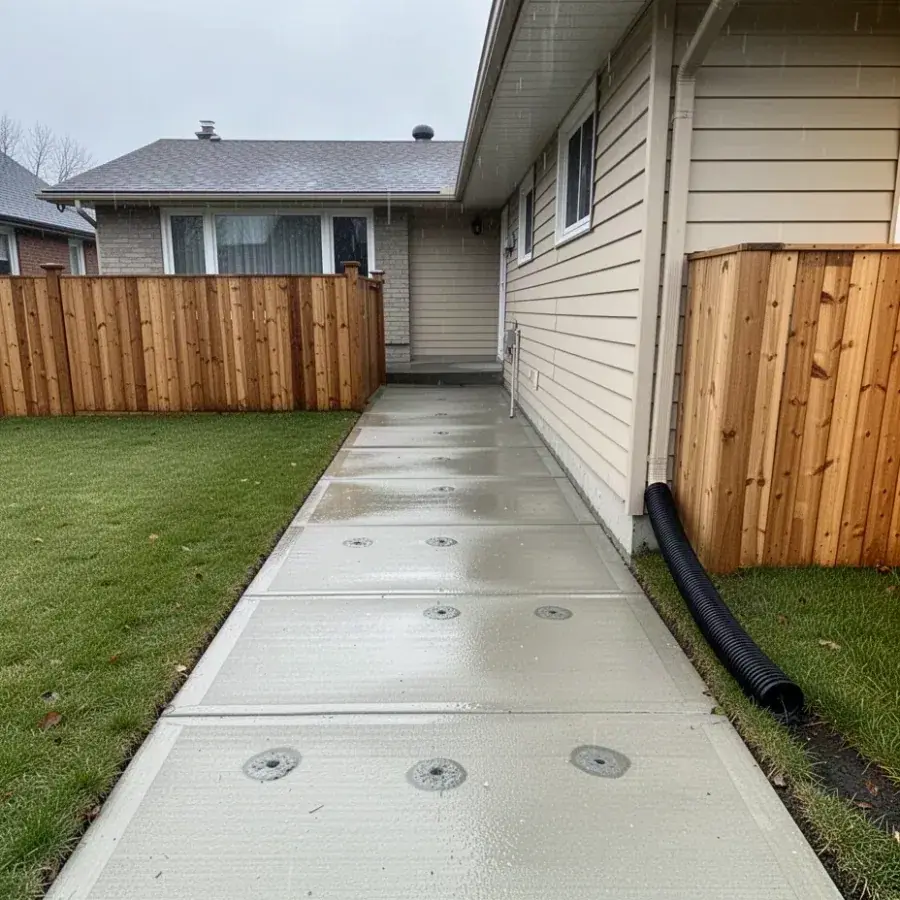
Sunken walkway panels are the most common trip hazard we are asked to fix. Lifting brings neighbouring panels flush so the joint between them is no longer something you notice underfoot.
Poured and precast steps often tilt away from the house as the soil beside the foundation settles. We lift them back against the wall and seal the gap so water cannot run behind them into the basement.
Settled patio panels pond water, and a sinking deck can tip toward the coping on concrete pool decks. Foam lifting corrects both without draining the pool or closing the yard for a week.
Garage slabs often crack and drop along the walls where the fill under them was never compacted. We lift the sunken section and seal the crack before it widens and lets meltwater from your car soak the base.
We level entrance slabs, sidewalk panels and loading areas for property managers on our commercial concrete program. Ontario Regulation 239/02 flags sidewalk steps over 2 cm on municipal walks, and many private sites use the same benchmark.
Concrete sinks because the soil under it shrinks, washes out or was never compacted properly. The slab itself rarely fails first; it loses support and drops into the empty space below.
Downspout washout is the leading cause we find in Cambridge. A downspout emptying at the edge of a walk or step carries fine soil out from under the slab every storm until a cavity forms.
Poorly compacted foundation backfill comes next. Soil pushed against a new foundation keeps consolidating for years, so steps and driveway aprons poured over it often settle 25 to 75 mm.
Edge erosion happens where a slab has no shoulder support and runoff undercuts it. Voids from rodents or plumbing leaks show up as a sudden local dip, often near a hose bib or under a garage floor.
Freeze-thaw cycles make every one of these worse. Water trapped in a void freezes and expands in January, then leaves a bigger hole behind in April.
Both methods fill the void and raise the slab, but the materials behave very differently. Polyurethane foam is a two-part expanding structural resin, while mudjacking (also called slabjacking) pumps a cement and limestone or soil slurry under the concrete.
| Factor | Polyurethane foam | Mudjacking |
|---|---|---|
| Injection hole size | About 16 mm (5/8 in) | About 25 to 50 mm (1 to 2 in) |
| Weight added to the soil | Roughly 2 to 4 lb per cubic foot | Roughly 100 lb or more per cubic foot |
| Cure time | Most strength within 15 to 30 minutes | 24 to 72 hours before loading |
| Water resistance | Closed-cell, does not wash out | Can erode if drainage is not corrected |
| Longevity | Many years once the cause is fixed | Several years, often less on wet soils |
| Relative cost | Typically 20 to 40% more per job | Lower material cost |
We recommend foam for most residential lifting because it adds almost no load to soil that has already proven weak, and the holes are smaller. Mudjacking can still make sense under thick commercial slabs with very large voids, where filling volume matters more than weight.
Lifting works when the slab is structurally sound and has simply dropped. A panel broken into two or three large pieces can usually be raised as a unit and the crack sealed afterward.
It does not work on concrete that is shattered, deeply scaled, or pushed up by frost or tree roots. Foam can raise a slab, but it cannot pull one down, and it does nothing for a surface that is flaking apart.
If the slab is level but the top is worn, our concrete resurfacing service is the better fit. If cracks and spalls are the main problem, start with concrete repair.
When a slab is past saving, we break it out through our concrete demolition and removal service and pour new, such as a replacement concrete driveway on a compacted Granular A base.
A typical residential lift takes two to four hours from setup to cleanup. Here is what happens on site.
We check elevations with a level and string line, probe for voids and trace where the water is coming from. Downspouts, grading and leaking hose bibs get flagged before anything is drilled.
We drill 16 mm holes through the slab, typically spaced 1 to 1.5 m apart. Ports stay back from joints and edges so the concrete does not spall.
Foam goes in through short shots while a laser level or dial gauge tracks movement. We raise the slab a few millimetres at a time so it comes up evenly instead of cracking.
Each port is filled with a cementitious patching mortar. We tint and texture the patch to sit as close to the surrounding surface as that concrete allows.
Gaps along the house and between panels get closed-cell backer rod and a self-levelling polyurethane sealant. This is the step that keeps water from returning to the base and undoing the lift.
We extend downspouts, recommend grading fixes and point out anything else feeding water under the slab. A lift holds as long as the soil underneath stays dry.
Send two or three photos with a level or straightedge on the slab and we will tell you whether it can be lifted.
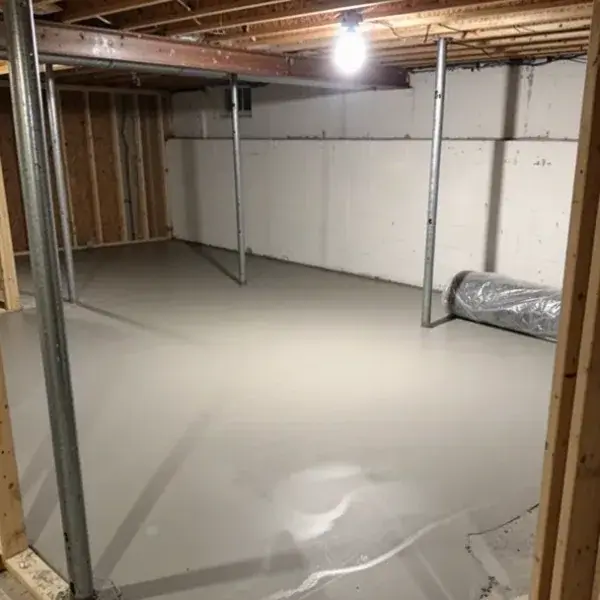
Interior floors usually need flattening rather than lifting, because the problem is an uneven surface, not a sunken slab. Before tile, vinyl plank or hardwood goes down, the floor must meet the flooring maker's flatness tolerance, typically 3 to 5 mm over 3 m.
We grind ridges and high spots with diamond tooling on a Husqvarna or HTC floor grinder connected to a HEPA dust extractor. Dips and low areas are then filled with a cement-based self-levelling underlayment from makers such as Ardex or Mapei, poured over the matching primer.
Most self-levellers take foot traffic in 2 to 4 hours and flooring within about 24 hours, depending on depth. Where a basement or shop needs a new slab instead of a skim coat, see our concrete floor installation service.
If an interior slab has truly sunk, foam can still be injected beneath it once plumbing lines and in-floor heating have been located.
Most residential concrete lifting jobs in Waterloo Region cost between $700 and $2,500 in 2026. Price follows how much material the void swallows, not just slab size, so two identical walkways can quote quite differently.
| Job | Typical 2026 range |
|---|---|
| Single walkway panel or stoop | $500 to $900 |
| Porch steps lifted and sealed to the house | $700 to $1,500 |
| Driveway apron or two to three driveway panels | $1,200 to $2,500 |
| Patio or pool deck section | $900 to $2,200 |
| Commercial sidewalk trip hazards | Often $250 to $500 per panel |
| Interior grinding and self-levelling | $4 to $9 per sq ft |
The factors that move the price are void volume, slab thickness, access for our equipment, the number of separate areas and how much joint sealing is needed. Most jobs carry a minimum charge to cover setup and travel.
Compared with tearing out and repouring, lifting usually costs 30 to 60% less and avoids a week without your driveway. Each job includes a written workmanship warranty covering the lift and the patching, provided the drainage corrections we recommend are carried out.
We lift and level concrete throughout Cambridge and anywhere within about a 45 minute drive. These are the communities we work in most.
Settled porches on older Galt and Preston homes, and dropped driveway aprons in newer Hespeler subdivisions.
Walkways and steps over backfill that is still settling in the city's newer neighbourhoods.
Townhouse walks and condo entrances, plus trip hazards on commercial properties.
Sunken driveways and patios in established and south-end neighbourhoods alike.
Long walkways and garage slabs on properties in Baden, New Hamburg and Petersburg.
Tilted steps and uneven sidewalks on older homes and downtown commercial frontages.
A foam lift lasts as long as the soil underneath stays stable, which is often a decade or more. The foam does not break down or wash out; re-settling happens when water keeps eroding the base, so fixing downspouts and sealing joints matters as much as the lift itself.
Yes. Polyurethane foam gains most of its strength within 15 to 30 minutes, so you can walk on a lifted slab right away and usually drive on a lifted driveway the same day once the patches set.
You will see small round patches about 16 mm across, far less obvious than mudjacking holes. We match colour and texture as closely as we can, but on coloured, stamped or exposed aggregate concrete the patches will still be visible up close.
We can lift as long as the ground under the slab is not frozen and it is warm enough for the patching mortar and sealant to cure. In Waterloo Region that usually means April through November.
Usually, by 30 to 60%. Replacement only wins when the slab is badly broken, deeply scaled or too thin to lift safely.
Tell us what sank and roughly when you first noticed it. Photos let us give you a reliable range before we visit.