Exposed Aggregate Driveways
Full driveways or aprons, built to the same base and mix spec as our concrete driveways and finished in stone.
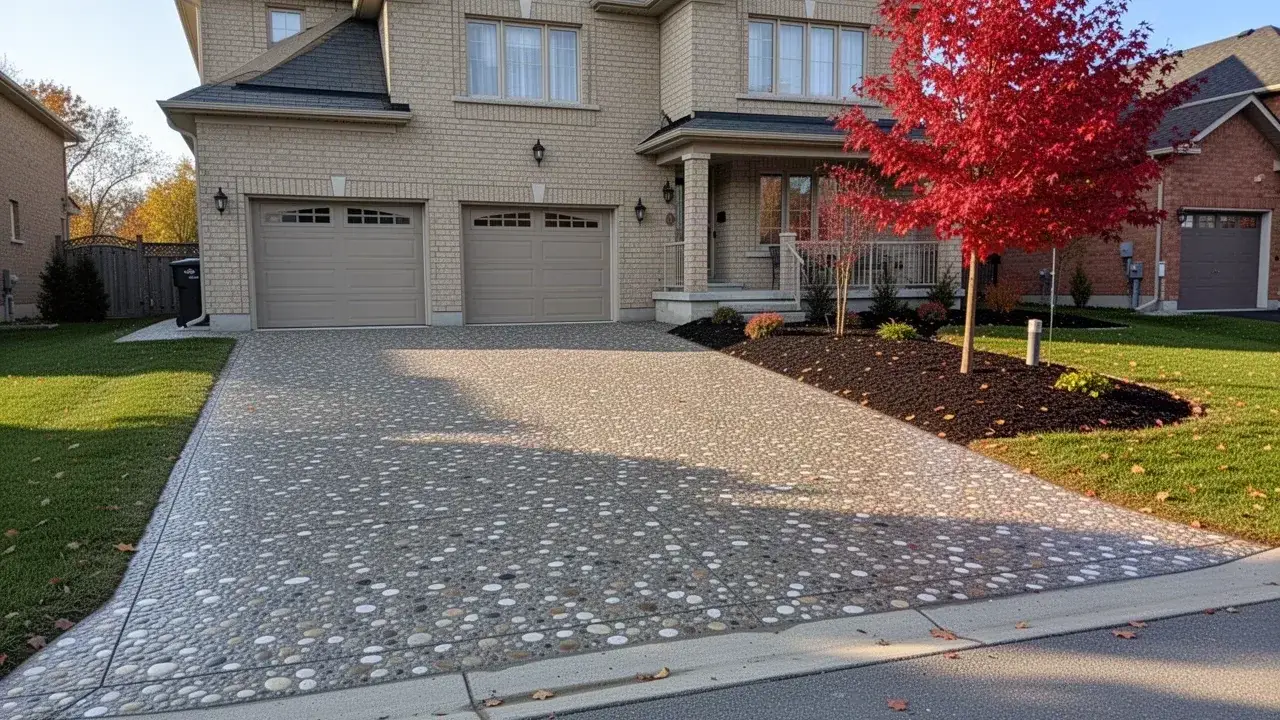
Stone-Textured Concrete
Sila Concrete Contracting installs exposed aggregate driveways, walkways and patios across Cambridge and Waterloo Region. Exposed aggregate is concrete with the top film of cement paste washed away to reveal the rounded stone inside, giving a natural pebble surface with real grip.
It has become a favourite for Ontario driveways because the stone gives tires and boots traction on icy mornings, and the busy texture hides tire marks, leaves and salt residue. We have built it on everything from narrow front walks to triple-wide driveways over 12+ years and 600+ jobs.
The finish looks simple, but it depends on washing the surface at exactly the right moment. That timing is the skill we bring, along with a written spec and a crew that is licensed, insured and WSIB covered.
Exposed aggregate works anywhere you want texture and traction in one slab. These are the surfaces we pour most.
Full driveways or aprons, built to the same base and mix spec as our concrete driveways and finished in stone.
Grippy paths from the driveway to the door that stay safe on frosty mornings. See concrete walkways for layout and width options.
A relaxed, natural texture for backyard living space; our concrete patios page covers sizes and shapes.
Small seeded stone that grips wet feet without feeling rough. Pair it with the drainage details on our concrete pool decks page.
A 300 to 450 mm stone band framing a broom-finished centre, the most affordable way to add the look.
Plaza walkways and building approaches that need durable grip; see our commercial concrete services.
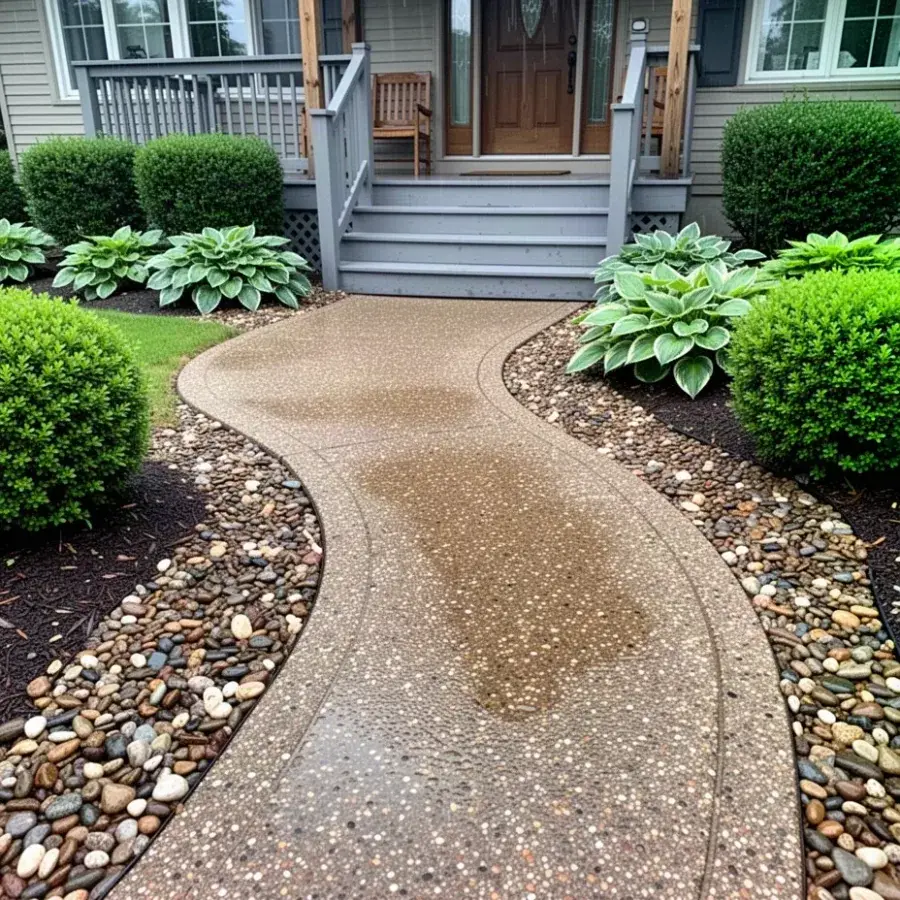
Natural mix aggregate is the stone already in the ready-mix, which in Waterloo Region is usually a rounded glacial gravel in greys, tans, whites and the odd pink. It is the most economical option and gives a classic, earthy look.
Seeded decorative stone is broadcast onto the fresh surface and floated in, so you can choose the exact stone: river rock, white quartz, black granite or mixed blends. Stone size matters as much as colour; 6 to 10 mm pea stone reads fine and feels smooth, while 14 to 20 mm reads bold and rustic.
A tinted base changes the paste between the stones, such as charcoal under white quartz or tan under river rock. We bring sample boards and photos so you can see each combination before it is ordered.
The pour is ordinary; the wash is not. Everything hinges on removing the surface paste while the stone is still held firmly by the concrete below.
We place a 32 MPa air-entrained mix with durable, well-graded stone over a compacted Granular A base. For seeded work, decorative stone is broadcast evenly and floated in until a thin layer of paste covers it.
A surface retarder such as GCP Top-Cast or Sika Rugasol is sprayed evenly over the finished slab. It delays the set of the top few millimetres while the concrete below hardens normally, and its strength is matched to the stone size.
Usually the next morning, though it can be 4 to 24 hours depending on temperature, we test a corner first. Then we scrub and pressure wash the paste away, exposing roughly a third of each stone so the other two thirds stay locked in.
Joints are sawcut once the surface is hard enough that the blade will not ravel stones loose, placed to keep panels close to square.
After a few weeks, a mild acid or buffered masonry cleaner removes the cement haze that dulls the stone. We neutralize and rinse it thoroughly so nothing etches the aggregate.
Once cured, about 28 days, the slab is sealed to lock the surface and bring out the colour of the stone.
Exposed aggregate has the best winter traction of the three and hides dirt best. Broom finish is the most economical, and stamped offers the widest range of looks.
| Factor | Exposed Aggregate | Stamped | Broom Finish |
|---|---|---|---|
| Winter traction | Excellent | Fair unless grit is added | Very good |
| Maintenance | Reseal every 2 to 3 years | Reseal every 2 to 3 years | Optional sealing every 2 to 3 years |
| Typical cost | Mid | Mid to high | Lowest |
| Look | Natural pebble texture | Stone, slate, brick or wood | Plain, clean lines |
| Hides tire marks and salt | Very well | Moderately | Poorly |
| Barefoot comfort | Good with small stone | Good | Good |
Want a pattern instead of pebbles? Compare our stamped concrete options.
Ask for our stone sample boards and a written quote for your driveway, walkway or patio.
Most exposed aggregate that disappoints was washed at the wrong time or with the wrong stone. These are the errors an inexperienced crew makes.
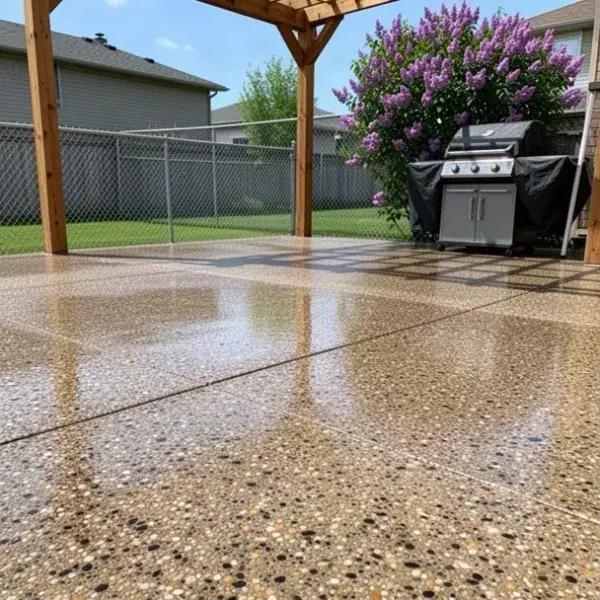
Seal exposed aggregate about 28 days after the pour and every 2 to 3 years after that. Sealer binds the surface paste around each stone, keeps salt water out and deepens the colour of the aggregate.
An acrylic sealer gives a wet look that makes the stone pop, while a penetrating silane or siloxane sealer protects without changing the appearance. On driveways we often recommend acrylic with a light grit so the glossy stone tops do not get slick.
Day to day, rinse off salt residue in spring, clean oil drips promptly and use a plastic shovel or a plow with a rubber edge. Our concrete sealing service can handle resealing for you.
Exposed aggregate driveways in Cambridge typically run $15 to $22 per sq ft in 2026, including removal of the old surface, a new base and reinforcement. New patios and walkways with no tear-out usually land around $14 to $20 per sq ft.
Your quote breaks out stone type, colour and removal so you can compare natural mix against seeded options side by side.
We pour exposed aggregate throughout Waterloo Region from our Kitchener base. Homeowners in Hespeler, Galt and Preston book us as their exposed aggregate contractor in Cambridge, and older driveways across the city keep our crews busy as a concrete contractor in Kitchener.
In Waterloo, seeded walkways and patios are popular requests for our concrete contractor in Waterloo team, while a concrete contractor in Guelph is what we are for owners east along Highway 7.
We also handle long country driveways as a concrete contractor in Wilmot Township and residential work as a concrete contractor in Brantford.
Yes, it is one of the best driveway finishes for Ontario winters. The stone gives excellent grip, and when the concrete is air-entrained to CSA A23.1 class C-2 and sealed, it resists salt and freeze-thaw well.
A few loose stones in the first season are normal, but widespread loss is not. It is caused by over-washing, weak or porous aggregate, or skipping the sealer, and we prevent it by exposing only about a third of each stone and sealing on schedule.
It depends on stone size. Large 14 to 20 mm stone can feel rough, so around pools and patios we recommend smaller 6 to 10 mm seeded pea stone, which grips wet feet but feels smooth.
Usually it is a little less. Natural mix exposed aggregate typically costs less than a multi-colour stamped pattern, while seeded decorative stone can bring it close to stamped pricing.
Not in a way that lasts outdoors. The stone has to be exposed while the concrete is still setting, so an existing driveway would need replacement or a thin decorative overlay instead.
Tell us what you want to pour and attach a few photos, and we will send a written quote with stone, colour and spec options.