Crack Routing and Sealing
We widen driveway and slab cracks into a clean reservoir with a crack chaser, then fill them with flexible polyurethane sealant. This keeps water and salt out of the base while letting the crack move with the seasons.
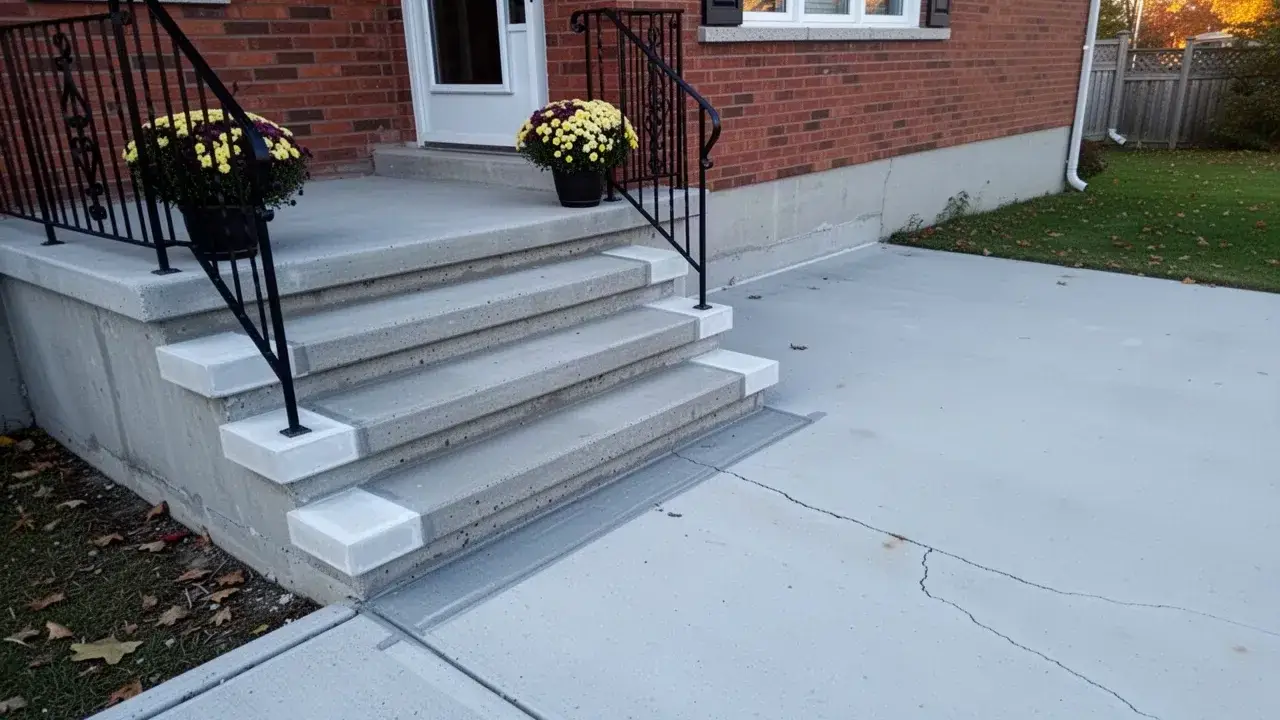
Crack and Spall Repair
Sila Concrete Contracting repairs cracked, spalled and broken concrete for homeowners, property managers and builders in Cambridge and across Waterloo Region. Our aim is to save sound concrete wherever we can, and to tell you plainly when a slab is beyond repair.
Good repair starts with diagnosis. A shrinkage crack, a settlement crack and a crack caused by rusting rebar can look alike from the driveway, yet each needs a different fix, and patching the symptom without correcting the cause is why so many repairs fail within one winter.
With 12+ years in the trade and more than 600 jobs behind us, our licensed, insured and WSIB covered crews fix driveways, steps, garage floors, walls and commercial concrete using materials chosen for Ontario road salt and freeze-thaw.
We repair residential and commercial concrete that is still structurally worth keeping. Each service below targets a specific kind of damage, so the fix matches the failure.
We widen driveway and slab cracks into a clean reservoir with a crack chaser, then fill them with flexible polyurethane sealant. This keeps water and salt out of the base while letting the crack move with the seasons.
Low-viscosity epoxy re-bonds structural cracks in walls and slabs, while expanding polyurethane resin seals cracks that leak. Leaking foundation cracks are covered in more depth on our concrete waterproofing page.
We cut out delaminated and flaking concrete, treat any exposed reinforcing steel and rebuild the surface with polymer-modified repair mortar.
Broken step edges and porch corners are rebuilt with pinned dowels and proper forms instead of a smear of patch that falls off by spring.
Salt-pitted patches, cracks and broken slab edges at the overhead door are repaired so the floor is safe and ready for a coating or sealer.
Failed, rotted or empty joints are cleaned out and refilled. For full joint layout and replacement, see our concrete expansion joints service.
We repair sidewalks, curbs, ramps and warehouse slabs for property managers through our commercial concrete program, with work scheduled around tenants and traffic.
The symptom tells you where to look, but the cause decides the repair. This is the diagnostic table we work from on a site visit.
| Symptom | Likely cause | Typical fix |
|---|---|---|
| Fine random cracks that appeared in the first weeks | Plastic or drying shrinkage | Monitor; rout and seal if wider than about 1 mm |
| Crack with one side lower than the other | Settlement or washout under the slab | Lift the slab, then seal the crack |
| Surface flaking off in thin patches | Freeze-thaw scaling, often from salt in the first winter or a mix without air entrainment | Remove loose material, patch, apply penetrating sealer |
| Chunks breaking out, rust stains | Corroding rebar or mesh too close to the surface (spalling) | Cut back to sound concrete, treat steel, polymer patch |
| Crack that opens in winter and closes in summer | Active thermal movement, missing control joints | Flexible polyurethane sealant, add a sawcut joint |
| Slab pushed up at a joint or near a tree | Frost heave or root pressure | Remove and replace the affected section |
| White powdery deposits | Efflorescence from water moving through the concrete | Clean, stop the water source, then seal |
Concrete poured with too much water, finished with bleed water on top or salted in its first winter is especially prone to scaling. That history matters, so we will ask how old the slab is and how it has been treated.
Repair is the right call when damage is local and the slab underneath is sound. The table below shows how we decide and what each option costs relative to full replacement.
| Option | When it fits | Rough cost vs replacing |
|---|---|---|
| Spot repair | A few cracks, isolated spalls, broken step corners | 10 to 25% |
| Lift and seal | Slab has sunk but is still intact | 30 to 50% |
| Resurface | Sound slab with worn or scaled surface over most of the area | 40 to 60% |
| Replace | Widespread structural cracking, heaving, deep scaling or a failed base | 100% |
Sunken but intact panels go to our concrete lifting and slab leveling crew, and slabs with a tired surface but solid structure suit concrete resurfacing. If more than about a third of a slab needs patching, replacement after concrete demolition and removal is usually better value.
We use professional repair systems, not bagged hardware-store patch. For structural crack injection that means low-viscosity epoxy such as Sikadur-52, and for leaking cracks a hydrophobic polyurethane injection resin.
Surface rebuilds use polymer-modified cementitious repair mortars from lines such as Sika MonoTop and SikaTop, which bond better and shrink less than plain cement. Flexible joints and routed cracks get a polyurethane sealant like Sikaflex.
Hairline cracks under about 1 mm are often cosmetic and can simply be watched. Active cracks that move with temperature are routed and sealed with a flexible sealant, while structural cracks in walls or thick slabs are injected with epoxy through surface ports until resin flows from the next port.
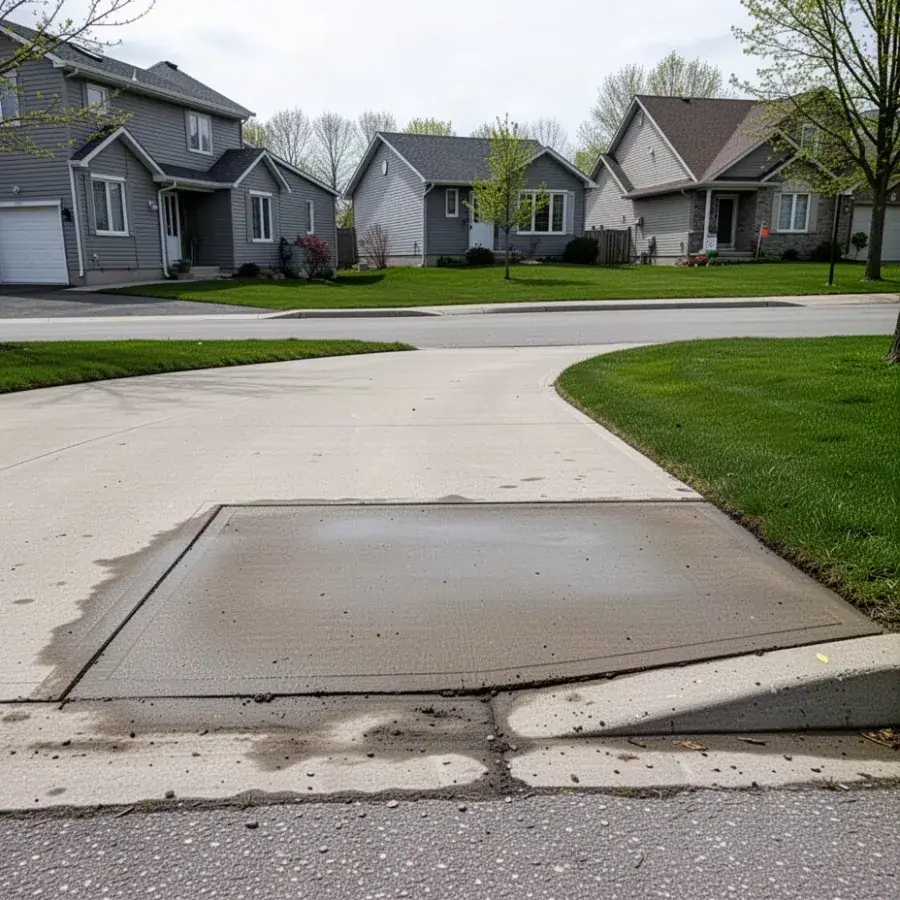
We patch salt-damaged areas, reseal joints and rebuild broken slab edges along the garage door and driveway apron. Edges are sawcut square, the substrate is wetted to a saturated surface dry state, and the repair mortar is placed and finished to match the surrounding texture.
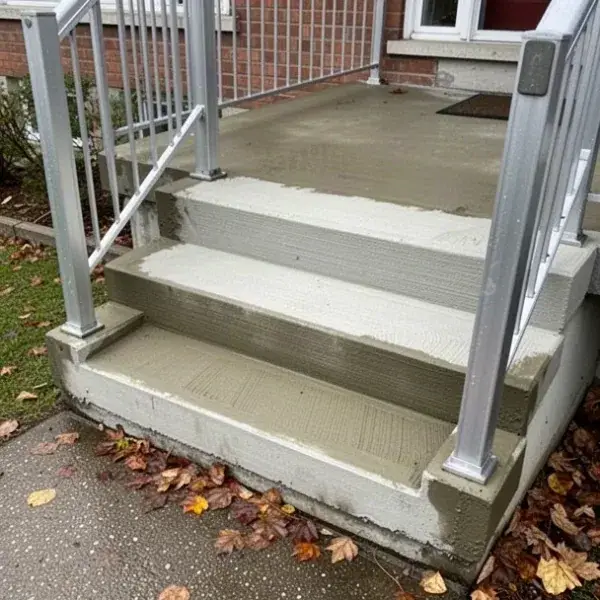
Broken step nosings are rebuilt, not just patched. We sawcut the damaged edge back to sound concrete, drill and epoxy-set stainless or galvanized steel pins, and build a timber form to the original rise and tread.
The new nosing is cast in a polymer-modified mortar or a fine concrete mix, with a light broom texture for grip. Pinning matters because a feather-edged patch without mechanical anchoring is what breaks off after the first hard freeze.
If the whole staircase has pulled away from the house, rebuilding corners will not fix the real problem. In that case we look at lifting the steps or replacing them through our concrete steps and stairs service.
Spalling is concrete breaking away in chunks, usually because reinforcing steel near the surface has rusted and expanded. Road salt carried in on tires speeds this up, which is why it shows up first at the end of driveways and in garage floors.
We sound the area with a hammer to map every hollow, delaminated spot, then sawcut and chip back to solid concrete. Exposed steel is wire-brushed and coated with a corrosion-inhibiting primer such as Sika Armatec before we place the repair mortar.
Once cured, the repaired area and the surrounding slab are protected with a penetrating silane or siloxane sealer. Without that last step, chloride from next winter's salt keeps attacking the steel.
We inspect the damage, sound for delamination, check for movement and look at drainage. You get a written scope that names the cause as well as the fix.
Downspouts get extended, low spots that pond water get addressed and sunken sections get lifted before any patching. Repairs over an unresolved cause do not last.
Damaged concrete is sawcut and chipped back to a sound, rough surface, then cleaned and pre-wetted. Good preparation decides most of a repair's lifespan.
We inject, rout and seal, or place repair mortar depending on the damage, working within each product's temperature range.
Patches are kept damp or covered with curing blankets so they gain strength without cracking. Most cementitious repairs accept foot traffic in a day and vehicles in a few days.
We finish exterior repairs with a breathable penetrating sealer, and can treat the whole slab through our concrete sealing service.
Send us photos of the cracks or broken areas and we will tell you whether repair, resurfacing or replacement makes more sense.
Most residential concrete repairs in Cambridge cost between $350 and $2,500 in 2026. Small crack sealing sits at the low end, and multi-step rebuilds or large spall repairs at the high end.
| Repair type | Typical 2026 range |
|---|---|
| Crack routing and sealing | $8 to $15 per linear foot |
| Epoxy injection of a structural crack | $450 to $900 per crack |
| Polyurethane injection of a leaking foundation crack | $500 to $1,000 per crack |
| Spalling and scaling patch repair | $20 to $45 per sq ft |
| Step nosing rebuild | $300 to $700 per step |
| Garage floor patching and joint resealing | $400 to $1,500 |
| Minimum service call | $350 to $500 |
Price depends on the amount of damage, how deep it goes, access, the products required and whether the cause needs correcting first. We include a written workmanship warranty on the repair itself; new cracks caused by later settlement or heaving elsewhere in the slab are not part of it.
Our repair crews cover Cambridge and the surrounding region, travelling up to about 45 minutes for repair assessments.
Step and porch rebuilds on older Galt and Preston homes, plus salt-damaged driveways across the city.
Garage floors, cracked driveways and foundation cracks on homes from every decade.
Crack sealing and spall repair for homeowners and multi-unit rental properties.
Driveway, walkway and step repairs on established streets and newer subdivisions.
Barn floors, shop slabs and farmhouse steps as well as village driveways.
Spalled steps, sidewalks and commercial entrances on older properties.
Most cracked concrete can be repaired if the slab is still level, the cracks are not widening quickly and less than about a third of the area is damaged. Replacement makes more sense when cracks run in every direction, pieces move underfoot or the base has failed.
Yes, to some degree. Sealant and patch mortar will never match weathered concrete exactly, though we choose grey tones and textures that blend in, and a sealer over the whole slab evens out the difference.
Late spring through early fall is best. Most cementitious repair mortars need at least 5°C and rising, and epoxies generally need about 10°C, so we avoid repairs when frost is forecast within 24 to 48 hours.
Usually because the cause was never fixed. Settlement, water under the slab or a missing control joint will keep cracking new concrete until it is addressed.
Yes. Structural cracks are injected with epoxy and leaking cracks with expanding polyurethane, and we also handle foundation leaks as a waterproofing job when the problem is wider than one crack.
Send photos and a short description and we will reply with a likely fix and price range. Worn but solid concrete may suit concrete resurfacing, and every repair can be protected afterward with concrete sealing.