Decks Around Vinyl Liner Pools
Cantilevered decks poured over the steel or polymer wall's coping, with the liner track protected and a rounded edge that is kind to swimmers.
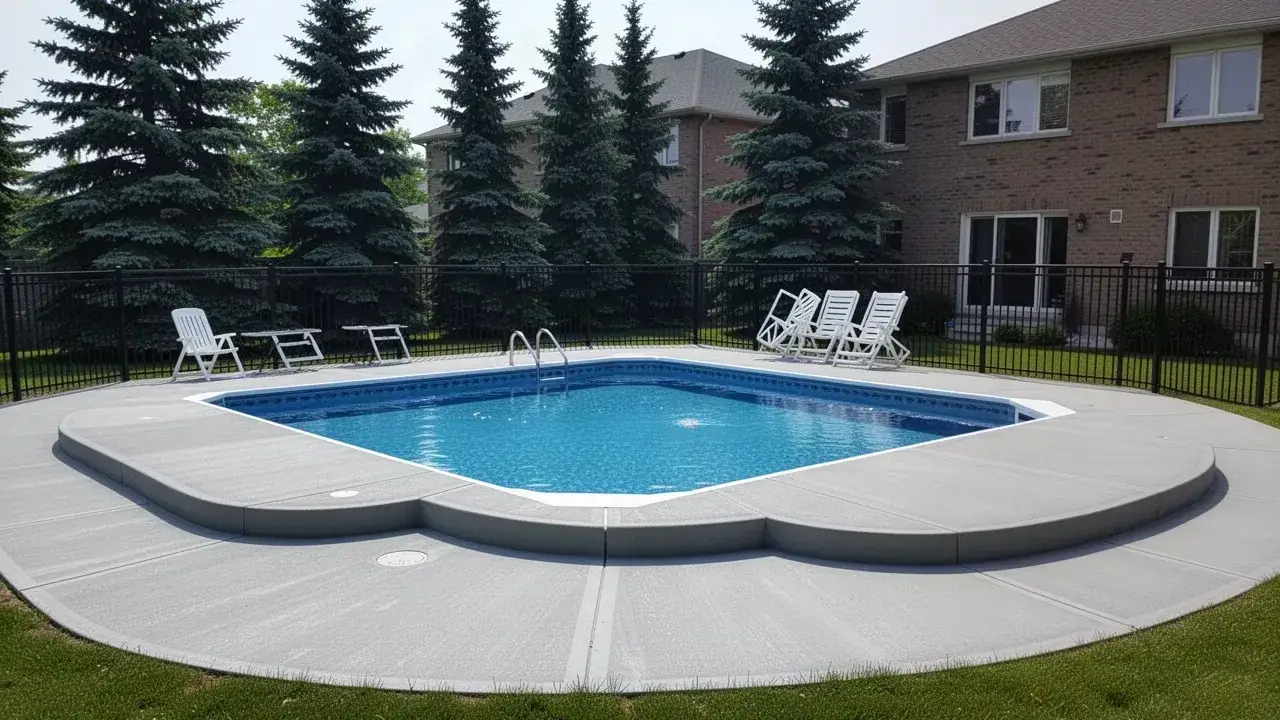
Pool Decks, Cambridge ON
Sila Concrete Contracting builds concrete pool decks for new pool installs and for tired decks that need replacing around an existing pool. We work alongside your pool builder and fence installer so the deck goes in at the right point in the schedule and the pool opens on time.
Over 12+ years and 600+ jobs, our crews have poured decks around vinyl liner, fibreglass and concrete pools across Cambridge and Waterloo Region. We are licensed, insured and WSIB covered.
A pool deck takes more abuse than any other backyard slab: wet bare feet, chlorine and salt splash-out, lounge chairs dragged across it and a full Ontario winter of freeze-thaw. We spec the mix, the texture and the joints for exactly that.
Whether the pool went in last month or twenty years ago, the deck around it can be built or rebuilt without fighting the pool itself.
Cantilevered decks poured over the steel or polymer wall's coping, with the liner track protected and a rounded edge that is kind to swimmers.
Poured against the shell's flange once backfill has settled, with a compressible joint so the shell and deck move independently.
Decks and coping that tie into the bond beam of a new concrete pool, finished to match the interior.
Careful saw-cutting and breakout around the pool edge, base rebuilt, and a new deck poured while the pool stays full.
Bullnose cantilever edges, precast coping stones or a square edge with a clean drip line.
Channel drains where the yard cannot take runoff, and reshaped slope where old decks ponded water.
For wet, bare feet, a light broom or knockdown texture gives the best mix of grip and comfort. Stamped patterns can work too, but only with anti-slip grit in the sealer.
| Surface | Grip when wet | Surface heat | Barefoot comfort |
|---|---|---|---|
| Light broom finish | High | Cool in natural grey | Good if brushed lightly across the walking direction |
| Knockdown or spray texture | High | Coolest; acrylic coatings reflect heat | Very good; soft, rounded texture |
| Stamped with grit sealer | Moderate to good with grit | Warm in darker colours | Good; deep grout lines can collect debris |
| Exposed aggregate (fine stone) | High | Moderate | Fair; coarse stone is hard on feet |
Knockdown is a cement-based texture troweled flat after it is sprayed on, leaving soft islands that grip without scratching. If you want a slate or stone look, our stamped concrete work around pools always gets a grit additive mixed into the sealer, and exposed aggregate concrete is best with a fine 6 to 10 mm stone.
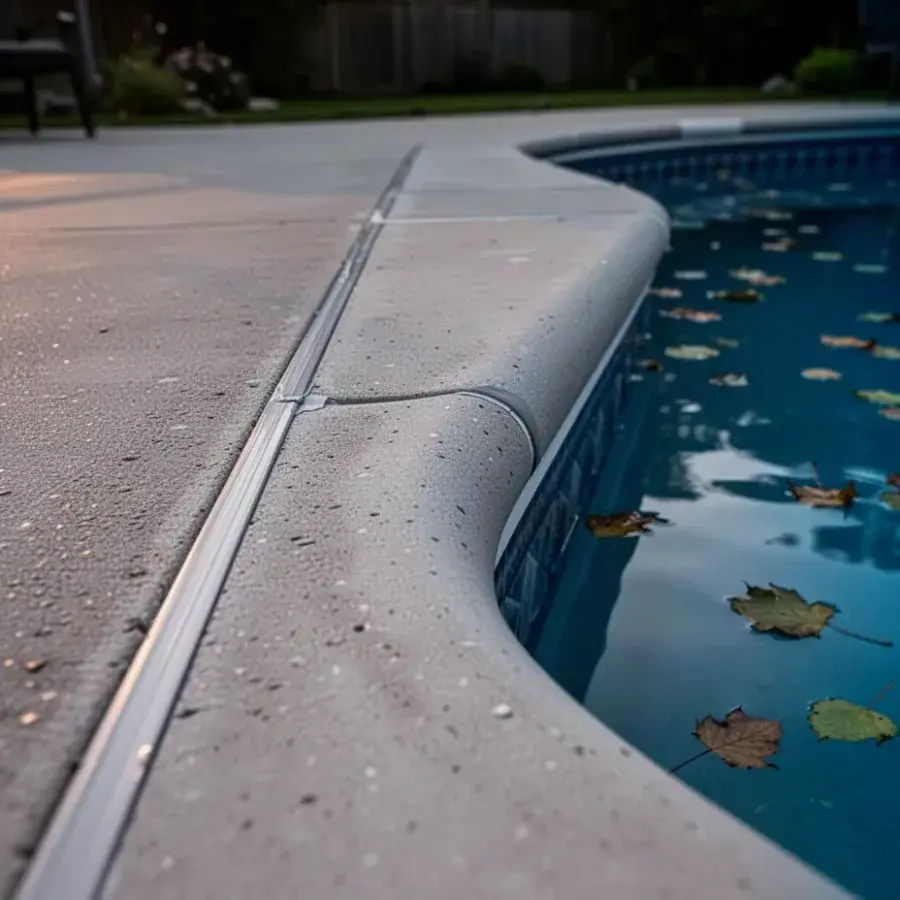
The pool edge is where most deck problems start. A cantilevered bullnose edge, formed with foam cantilever forms that come out after the pour, rolls over the coping and hides the liner track, while precast or natural stone coping gives a crisper border.
Every deck must shed water away from the pool so dirt and fertilizer do not wash in. We slope decks at about 1 to 2% toward the lawn where the yard can absorb it, and add slot or channel drains tied to a soakaway where fences, patios or neighbours make slope-to-lawn impossible.
Where concrete meets coping, we leave a compressible joint sealed with a flexible polyurethane sealant, a detail our concrete expansion joints crew handles. Without it, a deck expanding in July pushes on the pool wall and coping, cracking tiles and loosening the liner track.
Salt-water pools speed up surface scaling on pool decks. Splash-out leaves salt in the concrete's pores, and when that water freezes and the salt crystallizes, thin flakes pop off the surface, often within a few winters on a poorly built deck.
Chlorinated water does less damage than salt, but it still bleaches stained and coloured surfaces and breaks down cheap acrylic sealers. Both problems are slowed down by what goes into the slab and what goes on top of it.
We apply the first sealer coat about a month after the pour, and our concrete sealing service can reseal every 2 to 3 years before the surface starts absorbing water again.
Spring calendars fill fast, so send us your pool plans now and we will slot the pour around your builder's schedule.
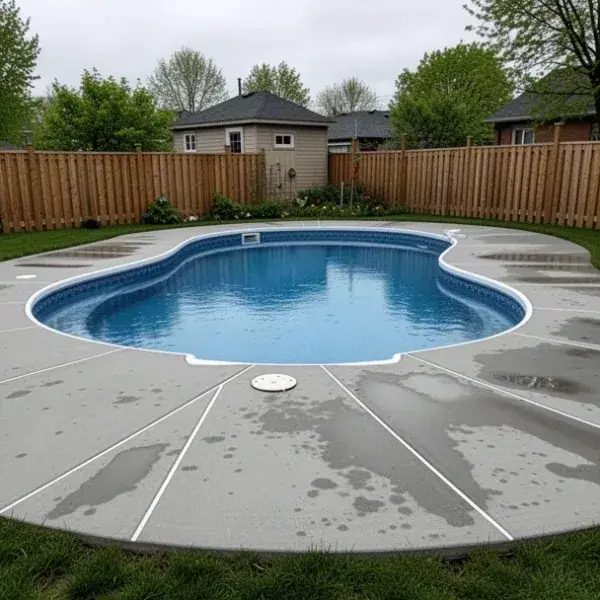
Most failed pool decks we replace were poured over backfill that had not finished settling. The ring of soil around a new pool is loose by nature, and if it is regular fill rather than clear stone, it keeps compacting for months under a fresh deck.
We ask pool installers to backfill with 19 mm clear stone, which locks together as it is placed, or we compact backfill in lifts before our base goes down. On heavy clay lots we add 10M rebar around the perimeter to bridge any soft spots.
The other common culprit is a deck with no joints near the pool corners. Re-entrant corners at steps and beach entries concentrate stress, so we cut joints from every inside corner straight out to the deck edge.
A typical pool deck takes 3 to 6 working days, spread across the pool builder's schedule. These are the stages.
We confirm backfill type, plumbing and electrical rough-ins, the pool deck's bonding grid inspection and where temporary fencing must stay during the work.
Liners, coping and skimmers are covered with poly and plywood, and the water level is set by the builder so wall pressure stays balanced.
We place and compact Granular A over the settled backfill, set cantilever forms at the pool edge and edge forms to the slope plan.
Larger decks are poured in sections, usually the pool surround first and the outer areas second, so the finishers keep up in summer heat.
We apply the broom, knockdown, stamp or exposed finish, then saw-cut joints within 24 hours and seal the coping joint.
No wash water or slurry goes into the pool; concrete residue spikes pH and can etch liners. The deck cures under a curing compound for 7 days.
After about 28 days we apply the sealer, ideally before the pool's first full season of use.
Most new concrete pool decks in Cambridge cost $14 to $30 per square foot in 2026, so a 600 sq ft deck around a 16 x 32 ft pool typically runs $8,500 to $18,000. These four factors move the price the most.
Square footage drives concrete, base and labour, but very small decks cost more per foot because setup is the same.
Light broom is the most affordable; knockdown adds about $3 to $5 per sq ft and stamped with colour sits at the top of the range.
Cantilever edges, precast coping and channel drains each add material and forming time along the pool perimeter.
Narrow side yards, fences and finished landscaping often mean a concrete pump, adding roughly $600 to $1,000 per pour.
Removing an old deck adds $4 to $8 per sq ft because breakout near the pool edge is slow, careful work. Your quote shows removal, base, concrete, finish, coping and sealing as separate lines.
We build pool decks from our Cambridge base throughout the surrounding cities and townships. Visit each area page for local details.
Pool yards in Hespeler, Blair and Preston, served by our Cambridge concrete contractor team.
Deck replacements and new installs with our concrete contractor in Kitchener.
Larger estate-style pool decks with our Waterloo concrete contractor crews.
Pool surrounds on Guelph's south-end lots, built by our concrete contractor in Guelph.
Rural and village pools in Baden and New Hamburg, see our Wilmot concrete contractor page.
Salt-water pool decks and replacements via our concrete contractor in Brantford.
A knockdown texture or a light broom finish is the least slippery choice for a concrete pool deck. Both give firm grip underfoot when wet, while stamped concrete needs anti-slip grit added to its sealer to come close.
Usually, yes. We keep the pool full so the walls stay supported, cover the water and liner with poly and plywood, and saw-cut the old deck back from the coping before breaking it out.
You can usually swim within 24 to 48 hours, once the deck is firm enough to walk on and the water chemistry is checked. Keep furniture off for 7 days and wait about 28 days before sealing or heavy use.
Ontario municipalities require a permitted pool enclosure, and in Cambridge the fence must be at least 1.5 m high with self-closing, self-latching gates. We plan the deck edge so fence posts land in the right spot, either cored through the concrete or set in the lawn beyond it.
If the slab is level and structurally sound, a polymer-modified overlay through our concrete resurfacing service can refresh it. Sunken, heaved or badly cracked decks need full replacement.
Send us your pool size, shape and timeline and we will price the deck, coping and drains in writing. Planning a new pool? See our concrete pool construction page, and browse stamped concrete and concrete sealing for finish and protection options.