Cast-in-Place Wood-Burning Pits
Round or square pits formed and poured on site, lined with firebrick and drained at the base, for properties where wood fires are permitted.
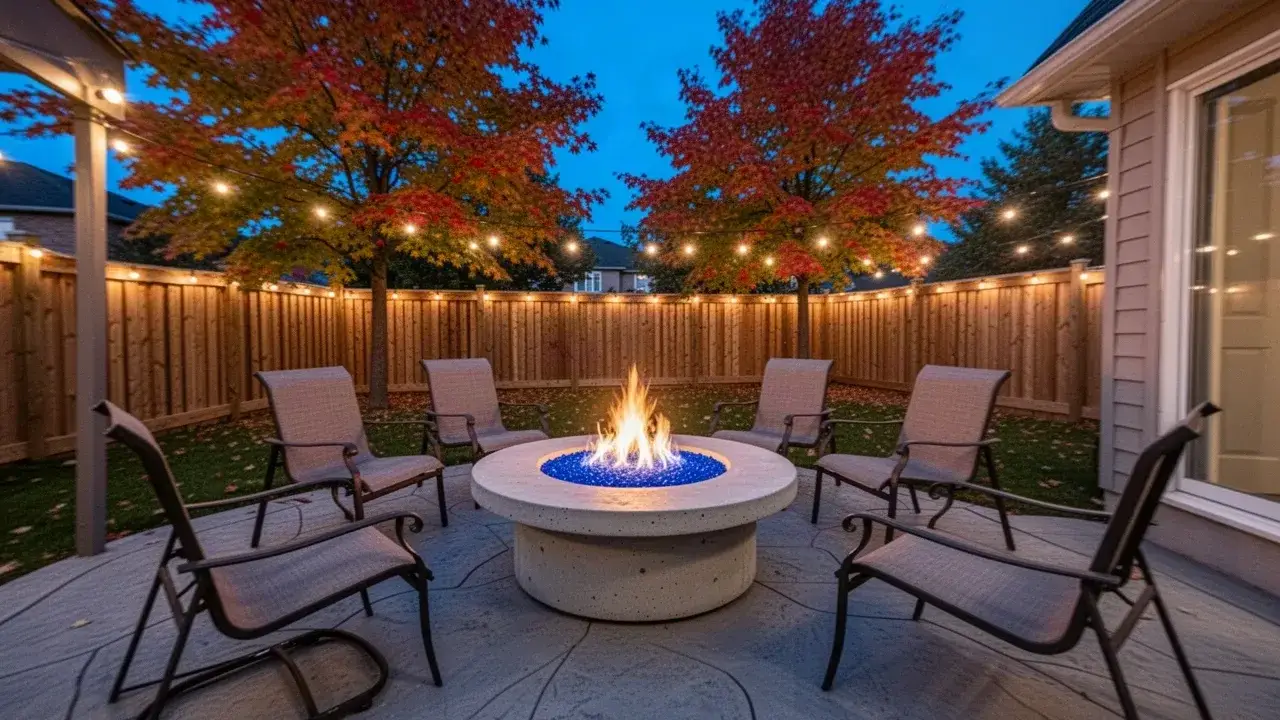
Built-In Fire Features
Sila Concrete Contracting builds custom concrete fire pits, fire tables and seat walls for backyards in Cambridge and across Waterloo Region. We design the fire feature with the patio around it, so the base, gas line and seating are planned together instead of bolted on later.
Most of our fire features run on natural gas or propane, because they suit city lots, start with a switch and leave no smoke for the neighbours. Where local rules allow wood fires, we build lined, drained wood-burning pits that will not crack from heat.
Homeowners and landscape designers count on our 12+ years in concrete and 600+ completed jobs for features that look right and stay safe. We are licensed, insured and WSIB covered.
Every fire feature we build is cast or assembled on site to fit your yard. These are the five we are asked for most.
Round or square pits formed and poured on site, lined with firebrick and drained at the base, for properties where wood fires are permitted.
Table-height concrete surrounds around a certified burner, with room for drinks and a lid that turns it into a coffee table when off.
Precast or GFRC bowls on a pedestal, often set in pairs along a pool deck or entry.
Curved or straight concrete seat walls around the fire, with caps that match your countertops or coping.
A properly sized pad cut into or added beside your current patio so a new fire feature has solid support.
For most city lots in Waterloo Region, gas is the practical choice because open-air wood burning is tightly restricted. Wood-burning pits suit rural and acreage properties where local rules allow them.
| Factor | Wood-burning | Natural gas or propane |
|---|---|---|
| Ambience | Crackle, smell and real heat | Steady flame over fire glass or lava rock, moderate heat |
| Convenience | Split wood, light, tend and clean ash | Switch or key valve, off in seconds |
| By-laws | Often needs a fire department permit or is not allowed on urban lots | Generally treated as an appliance; confirm locally |
| Smoke | Yes, which can bother neighbours | None |
| Install cost | Lower, no gas line | Higher, burner plus gas line |
Gas connections are made by a TSSA-registered gas contractor using a licensed gas technician, to the CSA B149.1 installation code. We build the concrete, sleeve and burner pan; the gas fitter runs and tests the line and burner.
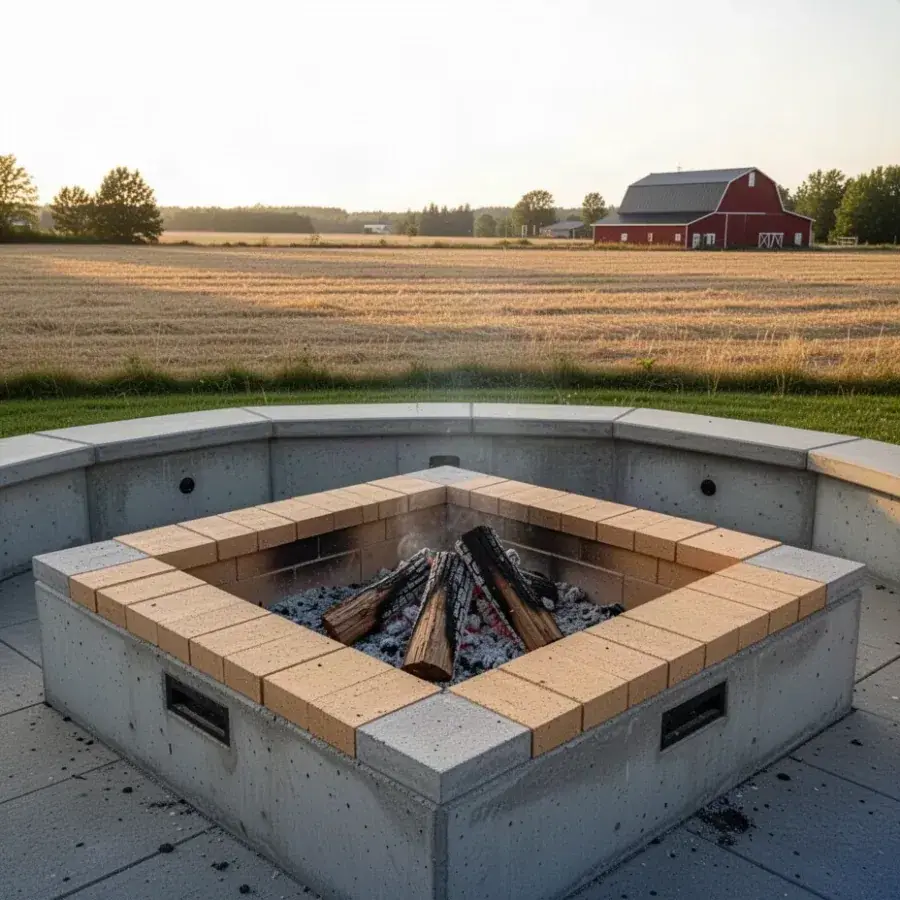
Ordinary concrete exposed directly to flame will eventually crack and spall, sometimes violently. The moisture trapped in its pores turns to steam, and the pressure blows chips off the surface.
Repeated heating also breaks down the cement paste and expands some aggregates, especially river gravel. That is why we never let flame touch structural concrete in a wood-burning pit.
Wood pits get a liner of firebrick set in refractory mortar, or a refractory castable rated for direct flame, with a small gap to the outer shell. Drainage holes at the base let rain escape so the pit does not hold water that later turns to steam.
Gas tables use a certified stainless burner pan and a heat shield sized so the concrete top stays at a safe temperature. The surround is vented so gas cannot pool inside.
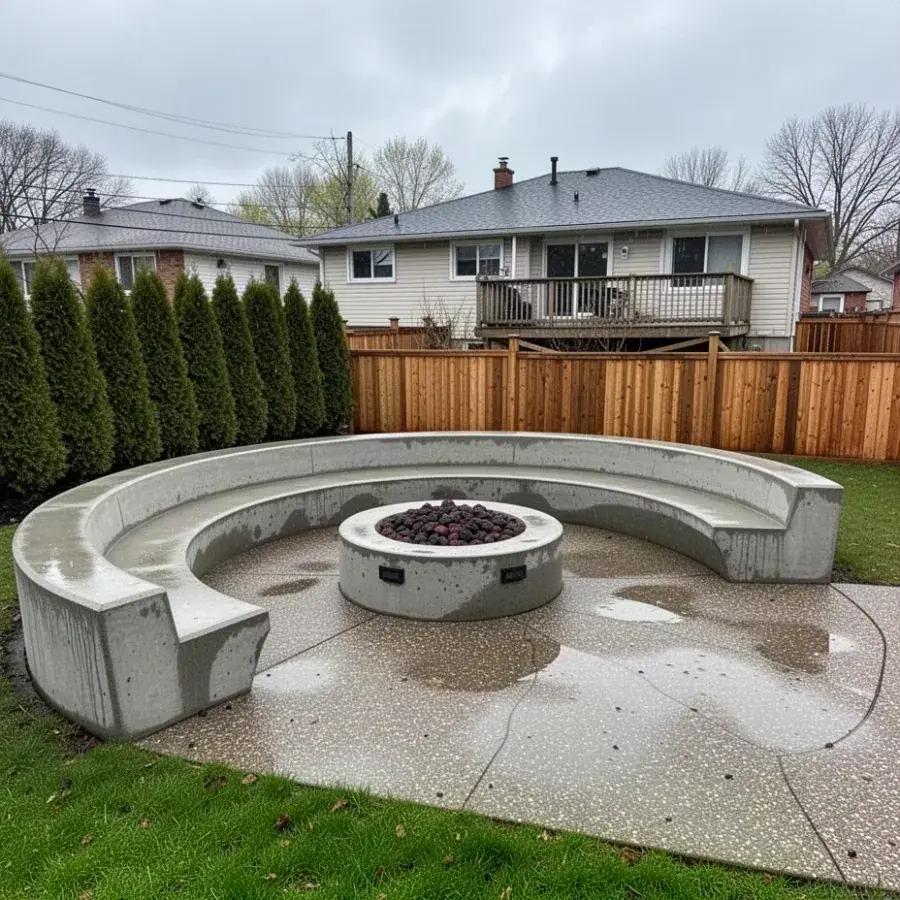
Put the fire where it is safe first and pretty second. As a starting point we plan at least 3 m (10 ft) from the house, fences, sheds and overhanging branches, then follow the appliance manual or local rules if they are stricter.
In Cambridge, the Open Air Burning By-law (313-86) requires a permit from the Fire Chief for open-air fires and bars setting a fire within 153 m of a building. On most city lots that rules out backyard wood fires, so we steer Cambridge homeowners toward gas and recommend calling Cambridge Fire before planning a wood pit.
Kitchener, Waterloo, Guelph, Wilmot and Brantford each set their own open-air burning rules, and fire bans can be declared in dry weather. Gas appliances under pergolas, roofs or umbrellas also need the overhead clearance their certification lists.
A cast-in-place fire pit usually takes 2 to 4 days of site work, plus curing before the first fire. Here is the order of work.
We confirm fuel type, size, seating height and placement, check your municipality's rules and pick a burner or liner.
Sod and soil come out, Granular A is compacted, and a reinforced 100 to 150 mm pad is poured or prepared, deeper where seat walls add weight.
Steel rings, tube forms or custom plywood forms shape the pit, with knockouts for air vents and access panels.
A PVC sleeve is cast through the base for the gas line, and a second one for wiring if you want electronic ignition or lighting.
We pour 32 MPa air-entrained concrete so the shell handles Ontario freeze-thaw, then finish the exposed faces to match your patio.
Firebrick or refractory castable goes in for wood pits; gas tables receive the burner pan, heat shield and fire media. A precast or cast cap finishes the top edge.
The shell cures for about four weeks before regular wood fires, starting with a few small fires to dry the liner. Gas units are tested by the gas fitter first.
Book a design visit now so the pit has time to cure before the cool nights arrive.
Most concrete fire features in Waterloo Region cost $2,500 to $9,500 in 2026, before any new patio. A cast-in-place wood-burning pit with firebrick typically runs $2,500 to $5,500, and a gas fire table $4,500 to $9,500 plus $800 to $2,000 for the gas line.
Larger diameters, long linear tables and custom shapes need more forming, concrete and labour.
Gas adds a certified burner, ignition system and a licensed gas line run from the house or meter.
Concrete seat walls typically add $300 to $500 per linear foot, more for curves and integrated lighting.
Smooth, sandblasted, coloured or stamped finishes and precast caps change the price, as does matching an existing patio.
Adding a fire pit pad to an existing patio usually costs $800 to $1,800. Many clients build the fire feature at the same time as a new concrete patio or stamped concrete surface, which saves a separate mobilization.
We build fire features for backyards throughout our service area, with rules that change at each town line. Gas fire tables are the go-to for a concrete contractor in Cambridge, for compact yards served by our Kitchener concrete team, and for new homes with our Waterloo concrete crew.
Larger lots and acreages open up more options, so we often design both gas and lined wood pits as a concrete contractor in Guelph, on rural properties as your Wilmot Township concrete contractor, and in backyards near the Grand River as a concrete contractor in Brantford, always after checking that municipality's burning rules.
Usually yes, if the patio is sound and at least 100 mm thick, or if we cut in a new reinforced pad for the fire feature. We also check clearances to the house, fences and trees, and plan the gas line route so it does not cross the patio later.
Cambridge's Open Air Burning By-law requires a Fire Chief permit for open-air fires and sets a 153 m distance from buildings, which most city lots cannot meet. Rules and fire bans change, so call the Cambridge Fire Department before building a wood-burning pit; gas fire tables are the common alternative.
Allow about four weeks of curing before regular wood fires, and start with a few small fires to drive moisture out of the liner. Gas fire tables can usually be used once the concrete has cured for a week or two and the gas fitter has tested the burner.
Not when it is built with air-entrained concrete, drained at the base and lined where flames touch. A cover keeps snow and ice out of the burner pan over winter.
Yes, we use the same pigments, finishes and caps across fire pits, seat walls and outdoor countertops so the whole space reads as one design.
Tell us about your yard, your fuel preference and how many people you want around the fire, and we will sketch options and send a written quote. Pair it with a concrete patio, an outdoor kitchen built with our concrete countertops, or a concrete pool deck for a complete outdoor space.
Call 226-895-3039 or fill in the form.