New Driveways
Driveways for custom homes, additions and lots where the builder left gravel. We grade for drainage away from the foundation before a single form goes in.
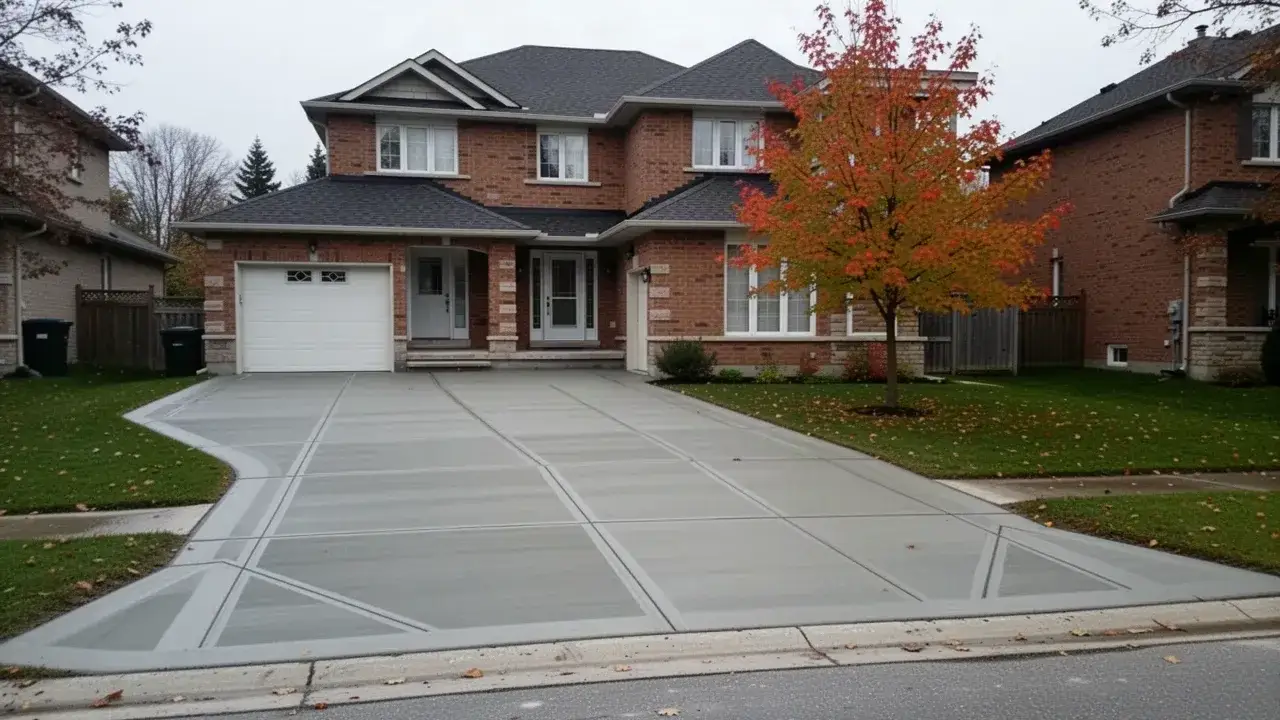
Cambridge, Ontario
Sila Concrete Contracting builds new and replacement concrete driveways across Cambridge and Waterloo Region, from clean broom finishes to stamped borders and exposed aggregate. Every slab we pour is designed for road salt and freeze-thaw, starting with a compacted Granular A base and a 32 MPa air-entrained mix.
We are a Kitchener-based residential and commercial concrete contractor with 12+ years in the trade and 600+ jobs completed. Homeowners call us when asphalt has rutted, interlock has heaved, or an older concrete driveway is scaling past the point of repair.
We are licensed, insured and WSIB covered, and every quote comes with a written spec sheet so you can see exactly what goes under and into your driveway before you sign.
We handle the whole driveway, from tearing out what is there to the last sawcut, with one crew responsible for the base, the steel and the finish.
Driveways for custom homes, additions and lots where the builder left gravel. We grade for drainage away from the foundation before a single form goes in.
Removal of failed asphalt, interlock or concrete, hauling, and a fresh base. Most residential replacements are finished in 3 to 5 working days.
Extra width for a second car or a trailer pad, tied into the existing slab with drilled dowels so the two sections move together.
Thicker slabs where the driveway meets the garage or the street, the spots that take turning tires and plow blades. We set an isolation joint against the garage slab so the two never bind.
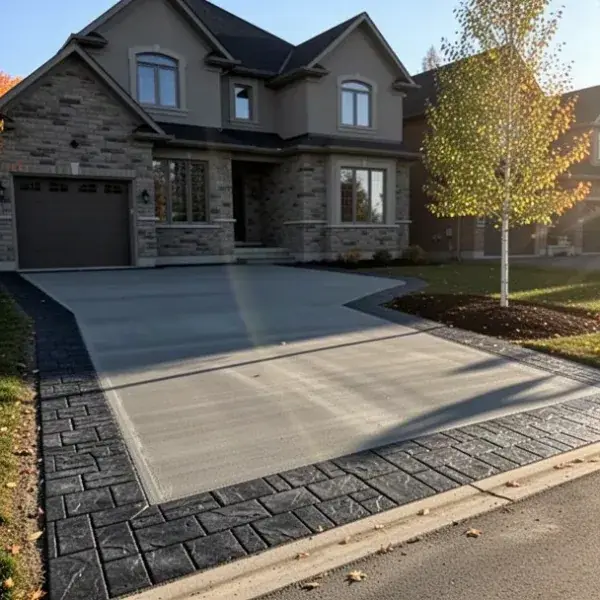
Decorative edges in stamped concrete or exposed aggregate concrete around a broom field. You get a custom look without paying decorative rates on the whole surface.
Snow-melt cable or tubing set into the pour during a replacement. See our heated driveway installation page for how the systems compare.
This service suits owners replacing cracked asphalt, sunken interlock or an old concrete driveway that has failed. For plazas, multi-unit lots and businesses, see our commercial concrete services.
Replace the driveway when the problem is in the base or spread across the whole slab. Patching only makes sense when the damage is local and the slab underneath is still sound.
If only one or two slabs have sunk, concrete lifting and slab leveling can raise them for a fraction of the cost. Isolated cracks and spalls are a job for concrete repair, and light surface wear on a solid slab can be renewed with concrete resurfacing.
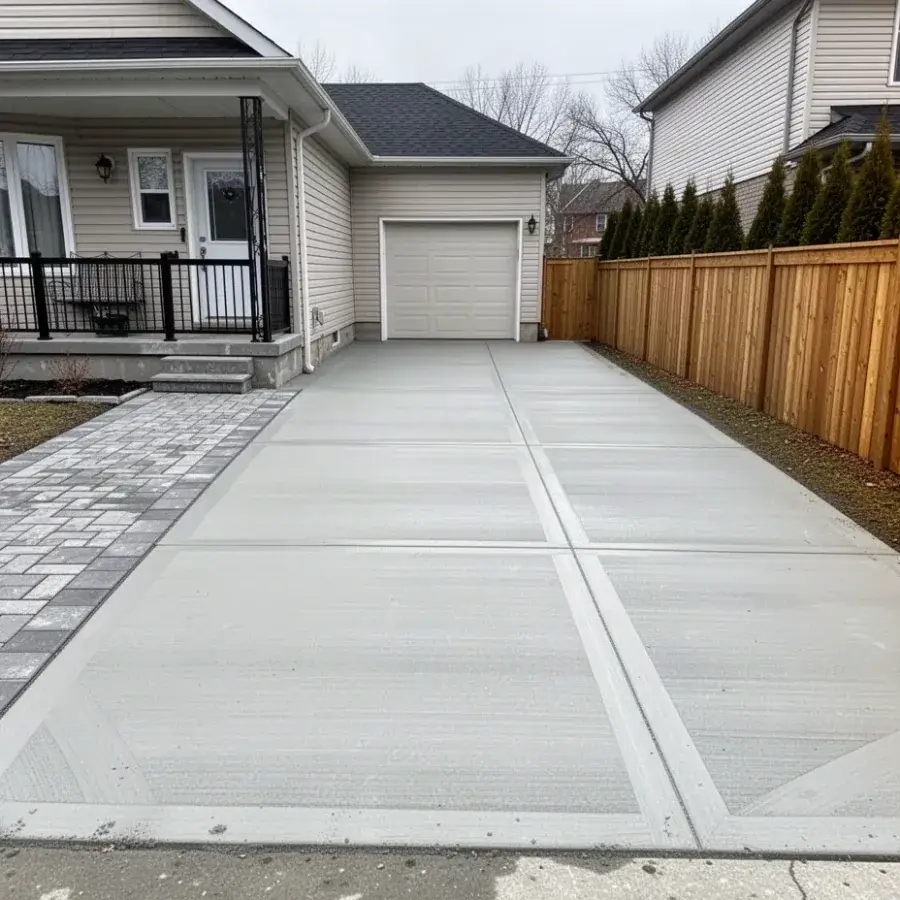
Concrete outlasts both. A well-built concrete driveway typically gives 25 to 40 years in Ontario, while asphalt usually needs resurfacing in 15 to 20 years and sealcoating every 2 or 3.
Interlock looks sharp when new, but individual pavers settle, polymeric sand washes out and weeds find the joints. A concrete slab has no joints to weed apart from the sawcuts, and it stays firm under a car's jack stand or a hot July sun when asphalt softens.
The trade-off is a higher upfront price than asphalt, which is why we spend so much time on the base: a cheap base wastes the extra money.
A broom finish is the standard for driveways because it grips well in winter and costs the least. The other finishes add character and cost, and each behaves differently once the snow flies.
| Finish | Look | Grip in Winter | Upkeep | Price Tier |
|---|---|---|---|---|
| Broom finish | Fine parallel lines, plain grey | Very good | Seal every 2 to 3 years | $ |
| Exposed aggregate | Natural stone surface | Excellent | Seal every 2 to 3 years | $$ |
| Stamped border, broom field | Stone or brick edge framing a plain centre | Very good field, fair on border | Reseal the border every 2 to 3 years | $$ |
| Integral coloured broom | Tinted throughout, warm tones | Very good | Seal to keep colour rich | $ to $$ |
Pigment mixed at the plant runs through the full slab depth, so chips do not show grey. Our coloured and stained concrete page covers tint options that pair well with brick and stone homes.
These are the numbers on our spec sheet for a typical Cambridge driveway. They follow CSA A23.1 for exterior flatwork exposed to de-icing salt (exposure class C-2).
| Item | Our Standard | Why It Matters |
|---|---|---|
| Slab thickness | 125 mm (5 in.) for cars; 150 mm (6 in.) at aprons and for RVs or work trucks | Thin slabs crack under point loads like jacks and delivery trucks |
| Concrete strength | 32 MPa at 28 days | The C-2 minimum for salt-exposed slabs |
| Entrained air | 5 to 8% | Microscopic bubbles give freezing water room to expand |
| Water to cement ratio | 0.45 maximum, no water added at the truck | Extra water weakens the surface and invites scaling |
| Base | 150 to 200 mm Granular A, compacted in lifts | Spreads load and drains frost-prone native clay |
| Reinforcement | 10M rebar on a 400 to 600 mm grid, or 6x6 W2.9 welded wire mesh, on chairs | Holds cracks tight; steel on the ground does nothing |
| Control joints | Sawcut to 1/4 of slab depth, roughly every 3 m | Gives shrinkage a planned place to crack |
| Slope | 1 to 2% away from the garage and house | Sheds meltwater before it can refreeze |
| Curing | Curing compound or wet cure for 7 days | Slow drying builds a harder, denser surface |
Rebar or mesh? We lean toward 10M rebar on wide driveways and over disturbed backfill, and use mesh on smaller, well-supported slabs. Our rebar reinforcement and wire mesh reinforcement pages explain the trade-offs in more detail.
A typical replacement takes 3 to 5 working days on site, plus a week of curing before you park on it. Here is what happens at each stage.
We book Ontario One Call utility locates before any digging, then mark the outline and set string lines for slope. Gas lines, irrigation and invisible dog fences are flagged so the excavator avoids them.
This is where most driveway failures start. Old material comes out, we dig to firm subgrade, and we place Granular A in lifts with a plate compactor, paying extra attention to the strip near the foundation where loose builder backfill settles for years.
Forms go in on true lines with the slope built in. Rebar or mesh sits on plastic chairs so it ends up in the middle of the slab, and we drill dowels into the garage apron or any slab we are tying into.
A crew of four to six places, screeds and floats the concrete, then pulls a broom across it once the bleed water is gone. We sawcut control joints within hours, before shrinkage stress builds up enough to crack the slab on its own.
We apply curing compound the same day. You can walk on the slab in 24 to 48 hours and drive on it in about 7 days, but skip rock salt and other de-icers for the whole first winter; use sand for traction instead.
Send us a few photos and rough measurements and we will come back with a written quote and spec sheet.
A broom-finished concrete driveway replacement in Cambridge typically runs $12 to $18 per sq ft in 2026, including removal, a new Granular A base and reinforcement. Exposed aggregate usually lands around $15 to $22 per sq ft, and stamped finishes higher still.
For a standard 600 sq ft double driveway, that puts most broom-finish replacements in the $7,500 to $11,000 range. Final pricing depends on the factors below.
Your quote lists each of these as a line item, so you can compare it honestly with an asphalt or interlock price.
In Cambridge, residential driveways are capped at a maximum width of 7 m, and at least 45% of the front yard must stay as landscaped open space. If you are widening, we lay out the new edge with both rules in mind before we quote.
Any change to the curb cut, or work on the City boulevard between the sidewalk and the road, needs approval from the City of Cambridge first. Widening a driveway apron at the street usually means an access permit, so we flag it early and help you through the application.
Some lots near the Grand and Speed rivers fall under Grand River Conservation Authority regulation, which can add a permit step for grading. We check the GRCA mapping for riverside properties during the site visit.
You get the spec in writing. Every quote states slab thickness, base depth, mix strength, air content, reinforcement and joint layout, so nothing is left to a verbal promise.
We are licensed, insured and WSIB covered, and we can provide a WSIB clearance certificate before work starts so you are not liable for an injury on your property. Every driveway comes with a written workmanship warranty that spells out what is covered.
With 600+ jobs completed across Waterloo Region, we know what local clay, salt and winters do to a slab built short.
Our crews pour driveways throughout Waterloo Region and nearby towns, all within about 45 minutes of Cambridge.
Our main market, from narrow driveways on older Galt lots to Hespeler and Preston subdivisions where builder asphalt is wearing out.
Close to our home base, with plenty of 1970s and 1980s driveways in neighbourhoods like Forest Heights and Doon now due for replacement.
Larger lots in Beechwood and Laurelwood where owners often add parking pads, stamped borders or heated tire tracks.
Replacements and new pours from the south end subdivisions to older homes near downtown.
Long rural and estate driveways around New Hamburg and Baden, often with wide aprons for trucks and trailers.
Full replacements and widenings across Brantford, a short drive down Highway 24 from Cambridge.
Our standard residential driveway is 125 mm (5 in.) thick over a compacted Granular A base. We go to 150 mm (6 in.) at the apron, for RVs, trailers and work trucks, and anywhere delivery vehicles turn.
A properly built concrete driveway typically lasts 25 to 40 years in Ontario. Salt in the first winter, a thin or soft base and water ponding against the garage are what shorten it, sometimes to 10 to 15 years.
Cars can go on after about 7 days, and foot traffic is fine after 24 to 48 hours. Wait about 28 days for moving trucks, RVs or loaded trailers, and allow extra time in cool fall weather when curing slows.
Yes. Removal, hauling and disposal are part of every replacement quote, and broken concrete goes to a recycling yard to be crushed into reusable aggregate instead of going to landfill.
All concrete shrinks as it cures, so we control where it cracks by sawcutting joints within hours of finishing. Hairline cracks inside those joints are normal and expected. Our written workmanship warranty covers defects in our installation, and the terms are on paper with your contract.
Yes, once it has cured for about 28 days. A penetrating sealer slows salt and water from getting in, and resealing every 2 to 3 years keeps it working; our concrete sealing service covers the options.
Tell us about your driveway and attach a few photos, and we will reply with a written quote and spec sheet. Thinking beyond plain grey? Ask us to price stamped concrete, exposed aggregate, concrete sealing or heated driveways alongside it.