Grind and Polish New Slabs
The best polished floors start as slabs placed for polishing. We pour, finish and cure the floor ourselves, then polish once it has gained strength.
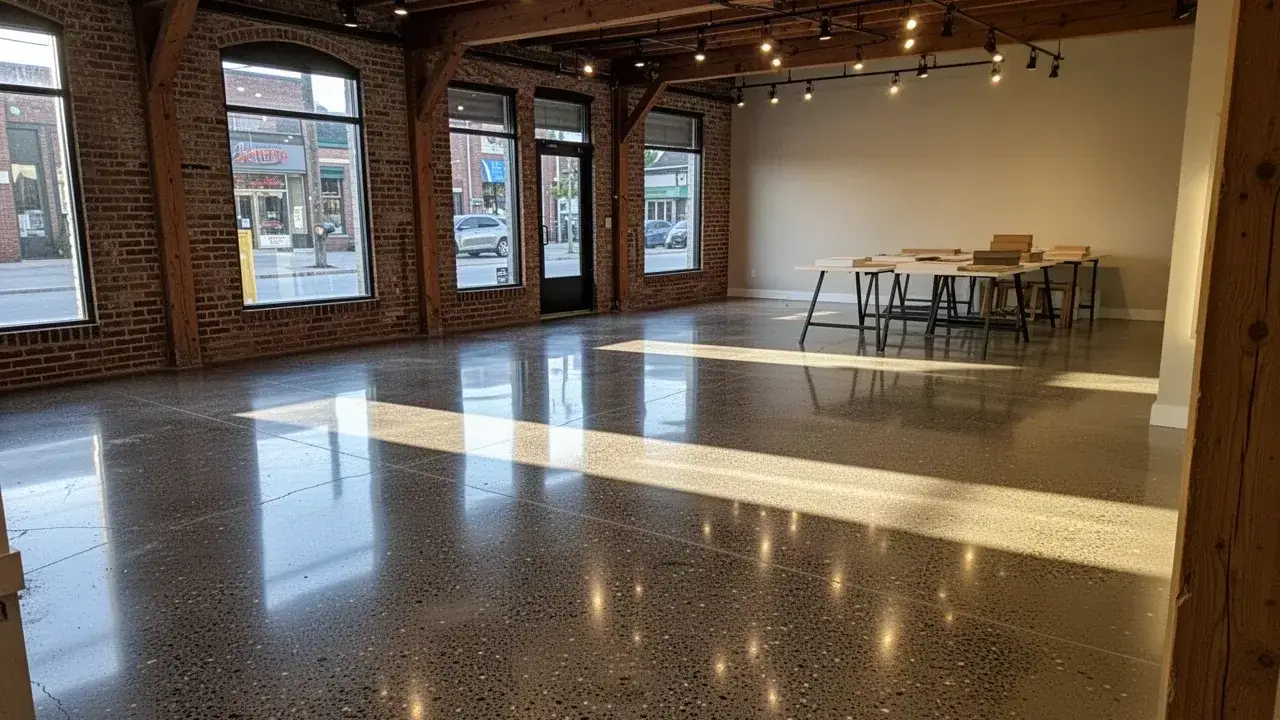
Diamond Ground Floors
Sila Concrete Contracting grinds and polishes concrete floors for basements, lofts, showrooms, breweries and warehouses across Cambridge and Waterloo Region. We polish new slabs we pour ourselves and restore existing floors that are tired, stained or covered in old coatings.
Polishing turns the slab you already have into the finished floor. Diamond tooling cuts and refines the surface, a lithium densifier hardens it, and a guard protects it, with no coating to peel.
Our crews bring 12+ years of concrete work and 600+ completed jobs to every floor, so we read a slab's hardness, flatness and history before quoting a finish. Homeowners, retailers and facility managers get a written scope that names the grit sequence and products.
Every polishing job starts with the same question: how much of the slab do you want to see? From there we pick one of five service paths.
The best polished floors start as slabs placed for polishing. We pour, finish and cure the floor ourselves, then polish once it has gained strength.
Older basement, shop and commercial floors can be ground flat, filled and polished. Stains and old patches often add character rather than hiding it.
Solvent or water-based dyes go in between grits for colour that wears with the floor, not on it. Saw-scored borders and logos are cut before dyeing.
A budget option: the floor is ground to a uniform look and finished with a topical sealer instead of full polishing. It suits basements and storage rooms.
Failed epoxy, paint, carpet glue and tile mastic come off with aggressive diamonds or PCD tooling. The bare slab can then be polished or prepared for a new coating.
Two choices define a polished floor: how deep we grind, which sets how much stone shows, and how far we polish, which sets the shine. The industry groups them as aggregate classes and gloss levels.
| Aggregate exposure | What you see | Grinding depth | Best for |
|---|---|---|---|
| Cream (Class A) | Smooth cement paste, little or no stone, a soft cloudy look | Surface only, about 1 mm | Residential spaces, slabs with fine finishing |
| Salt and pepper (Class B) | Fine sand and specks of small aggregate | About 1.5 to 3 mm | Retail, offices, most commercial floors |
| Full aggregate (Class C or D) | Medium to large stones across the floor, a terrazzo feel | 3 to 6 mm or more | Showrooms, lobbies, statement rooms |
Gloss levels run from 1 to 4. Level 1 is ground and flat, Level 2 is honed satin at about 400 grit, Level 3 is semi-polished at 800 grit and Level 4 is high gloss at 1500 to 3000 grit.
Cream finishes need a slab that was troweled very flat, because any dip will grind through to stone. Full aggregate hides imperfections best but takes the most grinding time.
Polished concrete outlasts coatings in most dry interior spaces because there is nothing on the surface to wear through. Epoxy wins where chemical resistance or a seamless wet-area surface matters.
| Factor | Polished concrete | Epoxy or polyaspartic | Sealed concrete |
|---|---|---|---|
| Durability | Very high; the floor itself is the wear surface | High, but can chip, scratch and delaminate | Low to moderate; sealer wears in traffic lanes |
| Slip when wet | Good dry, moderate wet; can be honed or treated | Slippery unless grit is broadcast in | Varies with sealer and gloss |
| Maintenance | Damp mop or auto-scrub, periodic burnishing | Recoat every 5 to 10 years in traffic | Reseal every 1 to 3 years |
| Typical cost | $5 to $14 per sq ft | $5 to $12 per sq ft | $2 to $4 per sq ft |
| Best spaces | Retail, warehouses, basements, lofts | Garages, labs, commercial kitchens | Storage rooms, utility areas |
Coated finishes are common on garage slabs exposed to road salt and hot tires, which we cover on our concrete garage floors page.
A typical 1,000 sq ft polish takes 2 to 4 days, depending on the target class and gloss. Here is the sequence and the chemistry behind it.
We scratch test with Mohs picks to choose diamond bonds, check flatness with a straightedge, and look for sealers, curing compounds and moisture problems. Soft slabs need a harder bond; hard slabs need a softer one.
A planetary grinder such as a Husqvarna PG or HTC Duratiq machine runs metal-bond diamonds from about 30 to 150 grit. This step sets the aggregate exposure and removes trowel marks, so it decides most of the final look.
Cracks and pop-outs are filled with a colour-matched epoxy or polyurea, often mixed with grinding dust so the repair blends in. Joints get a semi-rigid filler where traffic will cross them.
A lithium silicate densifier such as Prosoco Consolideck LS reacts with free lime in the paste to form extra calcium silicate hydrate. The surface becomes harder, less porous and much easier to polish to a deep shine.
Resin-bond diamonds take the floor through 100, 200, 400, 800 and up to 1500 or 3000 grit. Each pass removes the scratches of the one before, and skipping grits leaves swirl marks that show in raking light.
A penetrating stain guard such as Consolideck LSGuard or an Ameripolish guard is applied and heat burnished with a high-speed burnisher. It resists oil and food stains without forming a peelable film.
Our grinders run with HEPA dust extractors because grinding concrete releases respirable crystalline silica. That keeps the jobsite and the rest of your building clean.
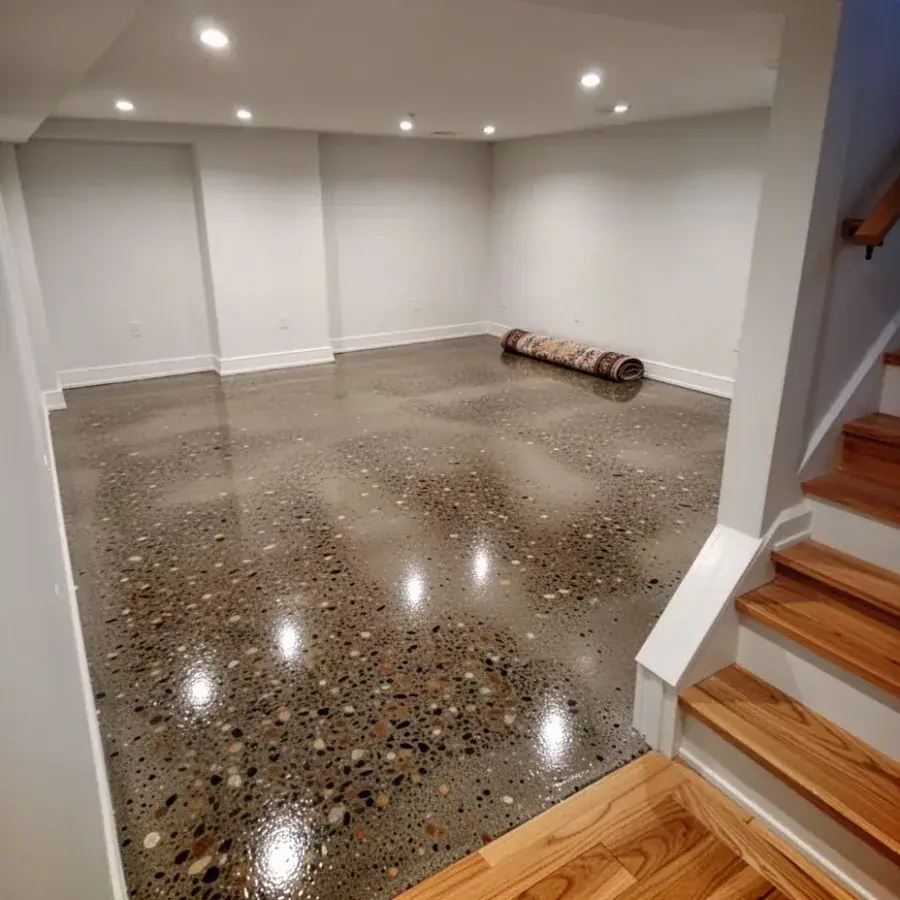
A new slab placed for polishing always gives the best result, because we control every variable from the mix to the cure. Existing floors can look excellent, but the outcome depends on their condition.
For a new slab, we pour with our concrete floor installation crew: a consistent mix with no added water, a hard steel-troweled finish, tight flatness and no film-forming curing compound. We wet cure instead, then protect the floor from drywall mud, pipe dope and oil while other trades finish.
For an existing floor, we look for patches, adhesive residue, deep stains, old sealers and uneven areas. Spalled spots may need concrete repair first, and badly curled joints can limit how even the aggregate exposure will be.
If you are building, call us before the pour. A short conversation with your builder can save thousands in extra grinding later.
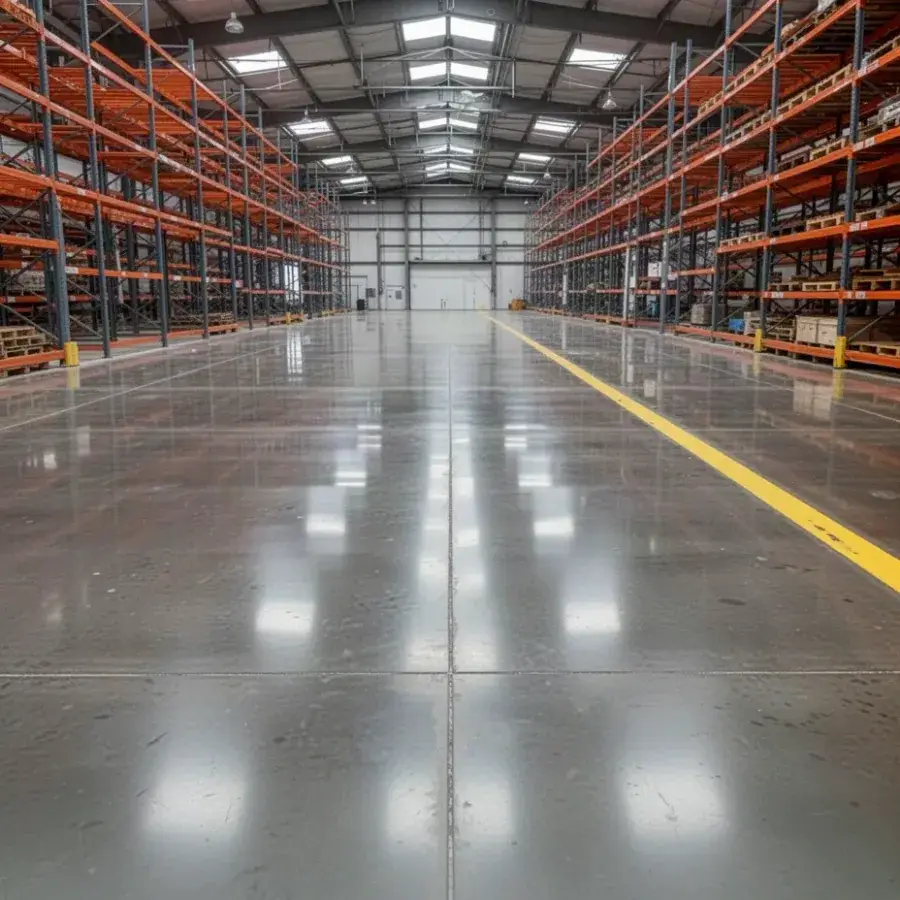
Warehouses, retail stores, breweries and car showrooms choose polished concrete for its low lifetime cost and bright, reflective surface. A high-gloss floor bounces overhead light and can make a space feel brighter without new fixtures.
Forklift traffic calls for a well-densified surface and joints filled with semi-rigid polyurea, installed once most slab shrinkage has happened, usually 60 to 90 days after the pour. Breweries and food plants need extra attention to acids, sugars and hot washdown water, which can etch a polished surface.
We schedule commercial grinding in phases, at night or on weekends, so stores stay open and racking can be moved section by section. See our commercial concrete services for larger projects and new-build slabs.
We can grind a small test patch on your existing slab so you see the real aggregate before you commit.
Polished concrete is easy to maintain if you clean it the right way. Daily care keeps the shine; the wrong cleaner can dull it in weeks.
High-traffic floors usually need the guard refreshed every 1 to 3 years, and a light repolish restores worn lanes without regrinding the whole floor.
Polished concrete floors in Waterloo Region typically cost $3 to $14 per sq ft in 2026, depending on finish level and floor condition. Residential rooms under 500 sq ft often carry a minimum charge.
| Finish level | Typical 2026 range |
|---|---|
| Grind and seal | $3 to $6 per sq ft |
| Cream or salt and pepper polish, 800 grit | $5 to $9 per sq ft |
| Full aggregate, high gloss | $8 to $14 per sq ft |
| Dye or colour | Add $1 to $2 per sq ft |
| Coating or adhesive removal | Add $2 to $4 per sq ft |
What drives price: the starting condition of the slab, how many grits it takes to reach your gloss, crack and joint filling, dyes and patterns, and total area. Large open floors cost less per sq ft than small rooms with many edges, columns and doorways.
Want colour without grinding? Our coloured and stained concrete options cover acid stains and integral colour for indoor and outdoor slabs.
Our polishing crews travel from our Kitchener base to homes and businesses within about 45 minutes of Cambridge. These are the towns where we grind and polish most often.
Dry polished concrete usually has good slip resistance, often better than waxed vinyl. It becomes slicker when wet, so for entries and wet areas we stop at a honed gloss, add an anti-slip treatment, or recommend mats, aiming for a wet DCOF of 0.42 or higher under ANSI A326.3.
Most sound slabs can be polished, but not every slab gives a uniform result. Very soft concrete, heavy cracking, deep oil saturation, failing patches or active moisture problems need repair first, and some floors are better suited to a grind and seal or a coating.
A well-polished floor can last decades because the concrete itself is the finish. Expect to refresh the guard every 1 to 3 years in busy spaces and do a light repolish when traffic lanes dull.
Not with proper equipment. Our grinders connect to HEPA-filtered dust extractors, and later polishing steps can be done with very little airborne dust.
Yes, if we know where the tubing sits and how deep it is. We limit grinding depth over shallow tubing, which usually means a cream or salt and pepper finish rather than full aggregate.
We will visit, test the slab's hardness and condition, and recommend a class and gloss level that suits the floor and your budget. Planning a new building or basement? Our concrete floor installation team can pour the slab with polishing in mind, and our commercial concrete group handles larger facilities.
Call 226-895-3039 or send the form with the details below.