Full Heated Driveways
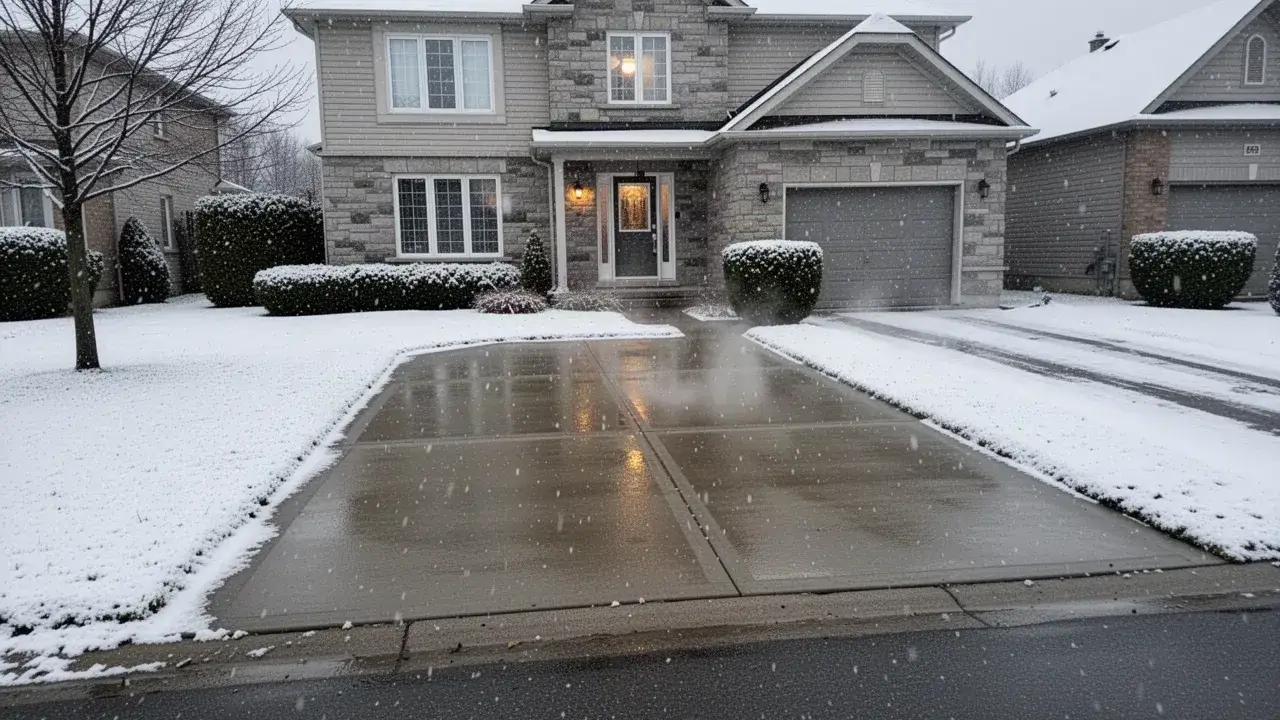
Edge-to-edge snow melting on a new or replacement driveway, built to the same base and mix spec as our concrete driveways.
Snow-Melt Concrete
Sila Concrete Contracting installs heated concrete driveways, walkways and steps that melt snow and ice on their own, so there is no shovelling, no snowblower and no rock salt eating the surface. An automatic sensor switches the system on when it snows and off when the slab is dry.
Heating cable or tubing has to be built into the slab, so the most practical time to add it is when a driveway is being replaced or poured new. We plan the base, insulation, joint layout and heating layout together, which is something a crew that only pours concrete rarely gets right.
We bring 12+ years and 600+ concrete jobs to every heated pour, and we coordinate the licensed electrical or gas trades the system needs. Homeowners with steep driveways, long walkways or mobility concerns tend to get the most value.
We heat the areas that matter most to you, from a whole driveway to just the steps. Every system goes into new concrete we pour ourselves.
Edge-to-edge snow melting on a new or replacement driveway, built to the same base and mix spec as our concrete driveways.
Two heated strips per lane where the wheels run. It cuts the heated area, the electrical load and the running cost roughly in half.
A clear, dry path from the driveway to the front door. See concrete walkways for layout options.
The most dangerous spot on most properties in January. Cable can run through treads and landings on new concrete steps and staircases.
Heating just the slope at the garage or a concrete ramp where ice is a fall or traction risk.
Heating cannot be slipped under an existing driveway. We recommend replacing the slab; a heated overlay is only possible where the surface can rise 50 mm or more.
Electric systems cost less to install and suit small to mid-size areas; hydronic systems cost more upfront but less to run on large driveways. Here is how they compare.
| Factor | Electric Cable | Hydronic Tubing |
|---|---|---|
| How it works | Heating cable or pre-spaced mats embedded in the slab | PEX-a tubing carrying heated glycol from a boiler |
| Typical system cost, installed | $15 to $25 per sq ft | $20 to $35 per sq ft, plus $8,000 to $15,000 for boiler and mechanical |
| Operating cost | Higher; billed on electricity | Lower; billed on natural gas |
| Best size | Walkways, steps, tire tracks, driveways up to about 800 sq ft | Large driveways and multi-area systems |
| Maintenance | Almost none beyond a yearly controller check | Annual boiler service, periodic glycol and pump checks |
| Permits and trades | ESA permit, licensed electrical contractor, ground-fault protection | TSSA-registered gas technician for the boiler and gas line |
| Electrical service | Full double driveway may need a 100 A or larger dedicated circuit | Minimal electrical load |
Electric cable for concrete comes from manufacturers such as nVent Raychem, and hydronic tubing from makers such as Uponor and Rehau. We confirm your electrical service capacity or boiler options during the site visit.
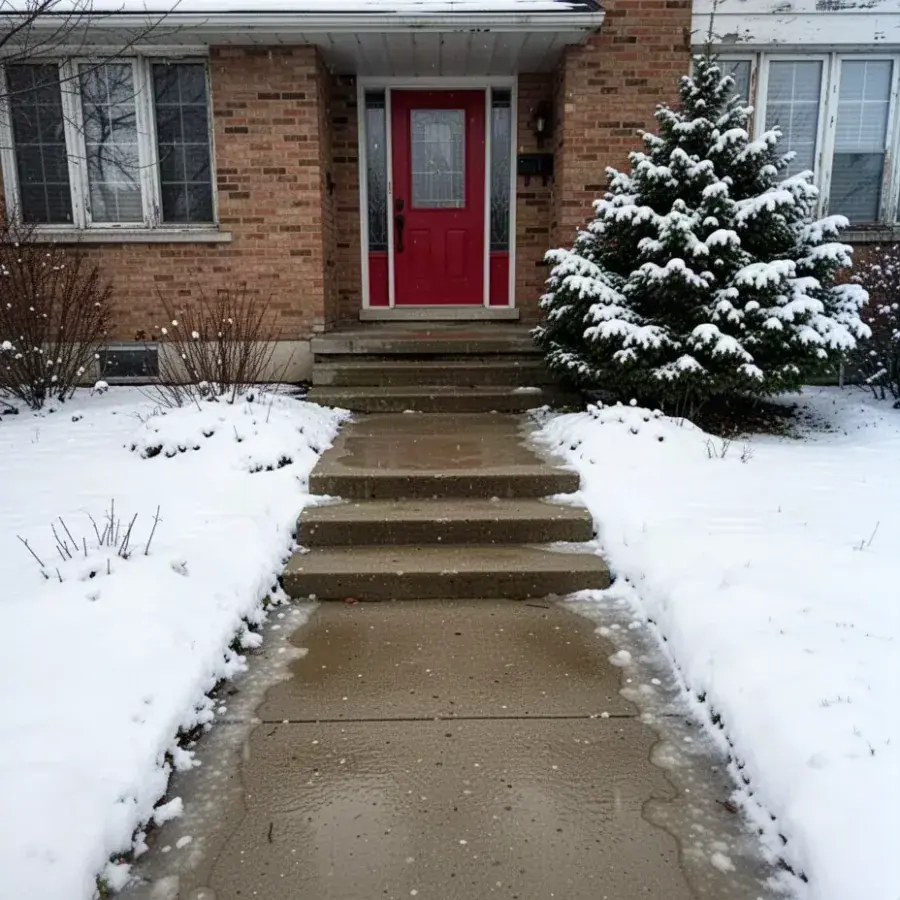
A heated driveway never needs de-icing salt, and salt is the main thing that shortens a concrete driveway's life in Ontario. Without chlorides soaking into the surface, there is far less scaling, pitting and rusting steel.
The slab surface also goes through fewer freeze-thaw cycles, because it stays above freezing during storms instead of thawing and refreezing daily. No snowbanks melt onto it and freeze overnight, and no metal shovels or plow blades chip the edges.
We still build every heated slab with 32 MPa air-entrained concrete to CSA A23.1 class C-2, because the system is off most of the winter. Heat protects the surface; the mix protects the concrete.
A heated driveway adds one to two days to a standard replacement. Most of that time goes into layout and testing, because nothing can be fixed easily once the concrete is placed.
We map the heated zones, cable or tubing spacing, sensor location and control joint lines on one drawing. Cable never runs along a sawcut line and only crosses joints at right angles in a protective sleeve.
Over a compacted Granular A base we lay 50 mm of high-density XPS insulation rated for vehicle loads, such as Styrofoam Highload. Insulation sends the heat up into the slab instead of down into the clay, which shortens melt times and cuts running costs.
Rebar or mesh goes in on chairs, then cable or PEX tubing is tied to it so it sits about 50 to 75 mm below the finished surface, well below our sawcut depth. Hydronic loops run continuous with no joints buried in the concrete.
Electric cable is checked with an insulation resistance (megohm) test and a continuity reading at each stage, and every value is recorded. Hydronic tubing stays under pressure on a gauge through the whole pour so any damage shows immediately.
The crew places concrete carefully around the heating, with no rakes dragged through it. Joints are sawcut to the planned layout and depth.
The licensed electrician or gas technician connects the controller, sensor and power or boiler. We wait for the slab to cure fully, about 28 days, before the system is run at full output.
That is the time to add heating, so ask us to price a heated option alongside your standard driveway quote.
A 600 sq ft electric heated driveway typically costs about $15 to $35 to run per snowfall, and a hydronic system of the same size about $5 to $12. Over a Waterloo Region winter with 15 to 25 melting events, that usually adds up to a few hundred dollars.
Electric snow-melt systems draw roughly 35 to 50 watts per sq ft, so a 600 sq ft driveway pulls about 27 kW while running, or about $4 to $5.50 an hour at all-in Ontario rates. Hydronic systems burn natural gas, which costs less per unit of heat, but the boiler adds its own upkeep.
| System (about 600 sq ft) | Per Typical Storm | Per Winter (Estimate) |
|---|---|---|
| Electric, full driveway | $15 to $35 | $250 to $850 |
| Electric, tire tracks only | $6 to $15 | $100 to $350 |
| Hydronic, full driveway | $5 to $12 | $100 to $300 |
Automatic snow sensors are what keep these numbers low, because the system runs only when there is moisture and the temperature is near freezing. Leaving a system idling all winter, or running it on a manual switch, can double or triple the bill.
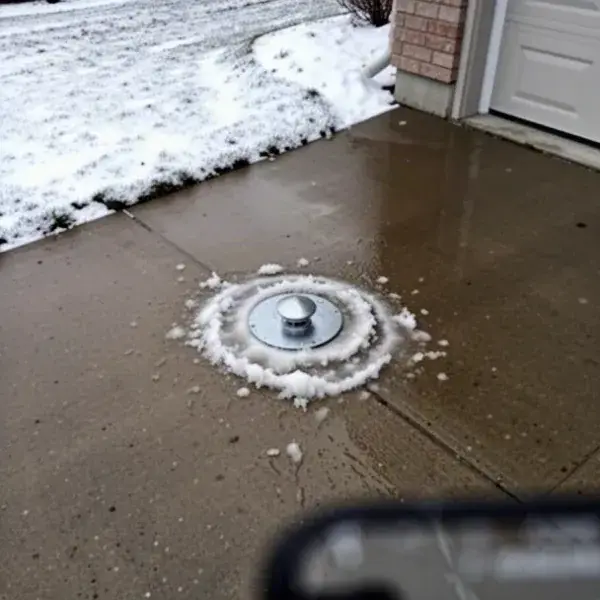
Every system we install runs on an automatic controller with a snow and ice sensor, from makers such as Tekmar or ETI. The sensor, set flush in the slab or mounted nearby, detects moisture plus a temperature around freezing and starts the system, then shuts it off once the surface is dry.
Controllers can also run an idle mode that keeps the slab just above freezing on very cold days, which speeds up melting when snow arrives. We set it up with you so you can balance response time against running cost.
Meltwater has to go somewhere, so we slope the slab to a lawn, a trench drain at the garage or a heated edge. Water that runs onto unheated concrete or a cold lip at the curb refreezes, which is the most common mistake we see on systems installed without a plan.
A heated concrete driveway with an electric system typically runs $27 to $43 per sq ft in 2026, covering removal, the new slab, insulation and the heating system. Hydronic driveways usually run $32 to $53 per sq ft, plus $8,000 to $15,000 for the boiler and mechanical room work.
For context, the concrete alone on a standard broom-finish replacement typically runs $12 to $18 per sq ft; our concrete driveway installation page explains what drives that part of the price. These factors move the heating portion up or down:
We install heated driveways and walkways throughout our service area, within about 45 minutes of Cambridge.
Usually not without replacing it. Heating has to be embedded in the concrete, so the practical options are a new pour or, where the surface can rise 50 mm or more, a heated overlay; cutting grooves into an old driveway for cable is not something we recommend.
For a 600 sq ft driveway, expect roughly $15 to $35 per snowfall with electric and $5 to $12 with hydronic. Over a typical Waterloo Region winter, that is a few hundred dollars, kept low by an automatic snow sensor.
Failures are rare when cable is tested through the pour, which is why we record readings at every stage. If a break does happen, it can be located with a fault locator or thermal camera, and a small section of concrete is cut out so the cable can be spliced with a manufacturer repair kit. Cable and tubing carry manufacturer warranties, and our installation is covered by our written workmanship warranty.
Most systems keep up with snowfall of about 25 mm an hour once warm. From a cold start, allow an hour or more before the surface clears, which is why idle mode helps on very cold days.
Electric systems need an Electrical Safety Authority (ESA) permit taken out by a licensed electrical contractor. Hydronic boilers and gas lines must be installed by a TSSA-registered gas technician, and we coordinate both.
Send photos of your driveway, walkway and electrical panel, and we will reply with options for full heating, tire tracks or walkways only. We quote heating together with the concrete, so see our concrete driveways page for what goes into the slab itself.