Exterior Foundation Membranes
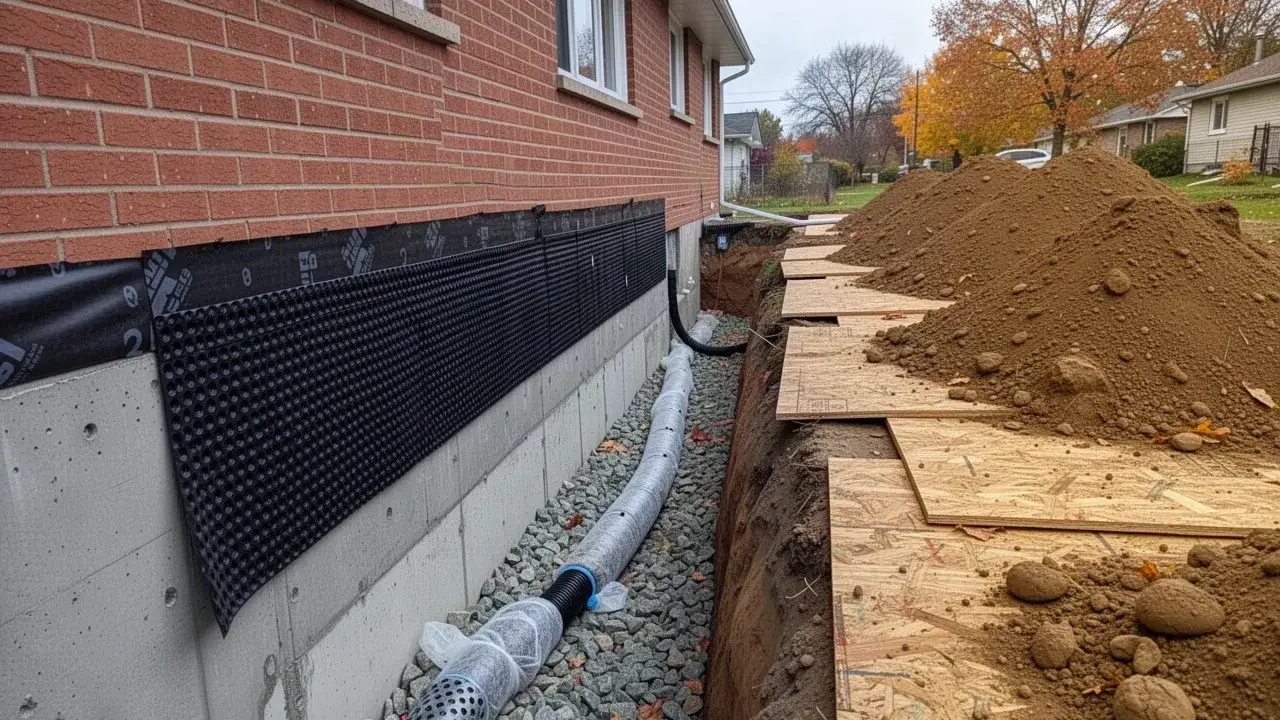
We excavate to the footing and apply a self-adhered rubberized asphalt membrane such as Henry Blueskin WP 200, covered with a dimpled drainage board like Delta-MS or Platon.
Foundation Waterproofing
Sila Concrete Contracting keeps water out of foundations, cold rooms and below-grade concrete for homeowners and commercial owners in Cambridge and across Waterloo Region. We install exterior membranes and drainage board, inject leaking foundation cracks and treat concrete with crystalline waterproofing.
Water gets into concrete wherever there is a crack, a joint or a gap in the drainage around it. Because we form and pour foundations ourselves, we know exactly where those weak points sit: the cove joint at the footing, the snap tie holes, the shrinkage cracks under basement windows and the porch slab over the cold room.
Our crews bring 12+ years of concrete experience and more than 600 completed jobs to every leak assessment. We are licensed, insured and WSIB covered, and we tell you which fix stops the water for good rather than the cheapest patch.
We waterproof concrete from the outside, from the inside, or both, depending on where the water is coming from and what access the site allows.
We excavate to the footing and apply a self-adhered rubberized asphalt membrane such as Henry Blueskin WP 200, covered with a dimpled drainage board like Delta-MS or Platon.
Leaking poured-wall cracks are injected from inside with expanding polyurethane resin that chases water through the full wall thickness. Structural cracks get epoxy through our concrete repair service instead.
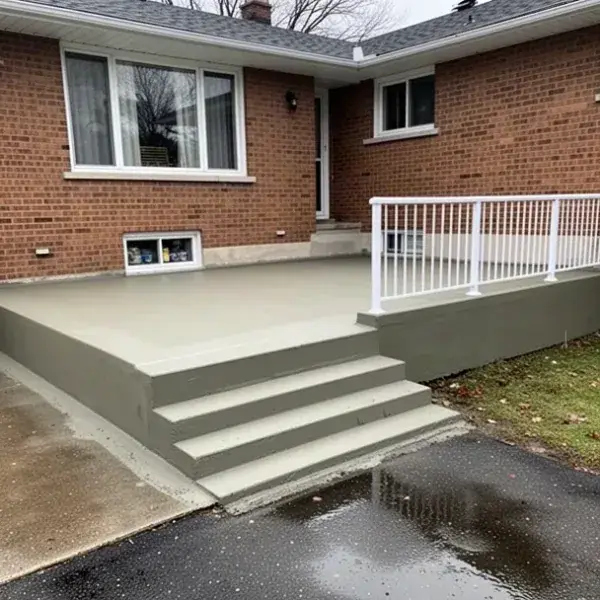
The cold cellar under a front porch leaks when the slab above loses its membrane. We waterproof or rebuild that slab and coordinate new concrete steps and stairs where needed.
Crystalline coatings such as Xypex Concentrate react with moisture and cement to grow insoluble crystals inside pores and hairline cracks. They are ideal where the outside of a wall cannot be reached.
We waterproof elevator pits, loading dock walls, below-grade parking walls and tanks for owners and builders through our commercial concrete division.
Dampproofing resists moisture vapour and soil dampness, while waterproofing resists liquid water under pressure. Section 9.13 of the Ontario Building Code treats them as different requirements, and most houses only get dampproofing.
Dampproofing is usually a thin sprayed or rolled asphalt emulsion on the outside of the foundation. It slows moisture from damp soil but cannot bridge a crack or hold back water standing against the wall.
Waterproofing is required by code only where hydrostatic pressure is expected, which is why a new home in a subdivision with good drainage rarely has it. When the weeping tile clogs or the water table rises, a dampproofed wall starts to leak, and that is usually when we get the call.
Most basement leaks come through a small number of predictable spots. Finding the actual entry point decides whether you need a single crack injection or a full exterior job.
Shrinkage cracks form as poured walls cure, often running down from window corners. Tie holes left by the snap ties that held the forms together can wick water if they were never sealed. Cove joints, where the wall meets the footing, are a cold joint that seeps once water builds up in the soil.
Failed weeping tile is the cause behind many whole-wall leaks; older clay tile cracks and newer pipe without a filter sock fills with silt. Properties in low-lying parts of Galt and Preston near the Grand River can also see seasonal high water tables that push water up through the floor slab and cove joint.
Exterior membranes stop water before it reaches the concrete, while interior methods deal with water once it is in the wall. This table shows how they compare on a typical Waterloo Region house.
| Method | Disruption | Typical cost | Permanence | Best for |
|---|---|---|---|---|
| Exterior membrane and drainage board | High: excavation, landscaping removed | Highest | Longest lasting, decades | Whole walls, recurring leaks, new builds |
| Interior crack injection | Low: done from inside in hours | Lowest | Long lasting for that crack | One or two leaking cracks in poured walls |
| Crystalline treatment | Low to moderate: surface prep inside | Moderate | Permanent once crystals form | Damp walls, pits, walls with no exterior access |
| Interior drainage system | Moderate: floor perimeter cut out | Moderate to high | Manages water rather than stopping it | High water tables, cove joint seepage |
Interior drainage controls water that gets in rather than keeping it out, so we recommend it mainly where the water table is the issue. For cracks alone, injection is almost always the first step.
A typical exterior foundation waterproofing job on one or two walls takes three to six working days. Here is the sequence.
We book utility locates through Ontario One Call and protect lawns, driveways and gardens with plywood and tarps. Decks, AC units and shrubs near the wall are moved or protected.
A mini excavator digs to the top of the footing, with hand digging near gas lines and service entries. The trench is kept stable and safe throughout.
The wall is scraped and washed down to bare concrete so we can see every crack, tie hole and honeycombed area.
Cracks are routed and filled with hydraulic cement or injected, and tie holes are plugged. The cove joint gets a fillet of compatible sealant or mortar.
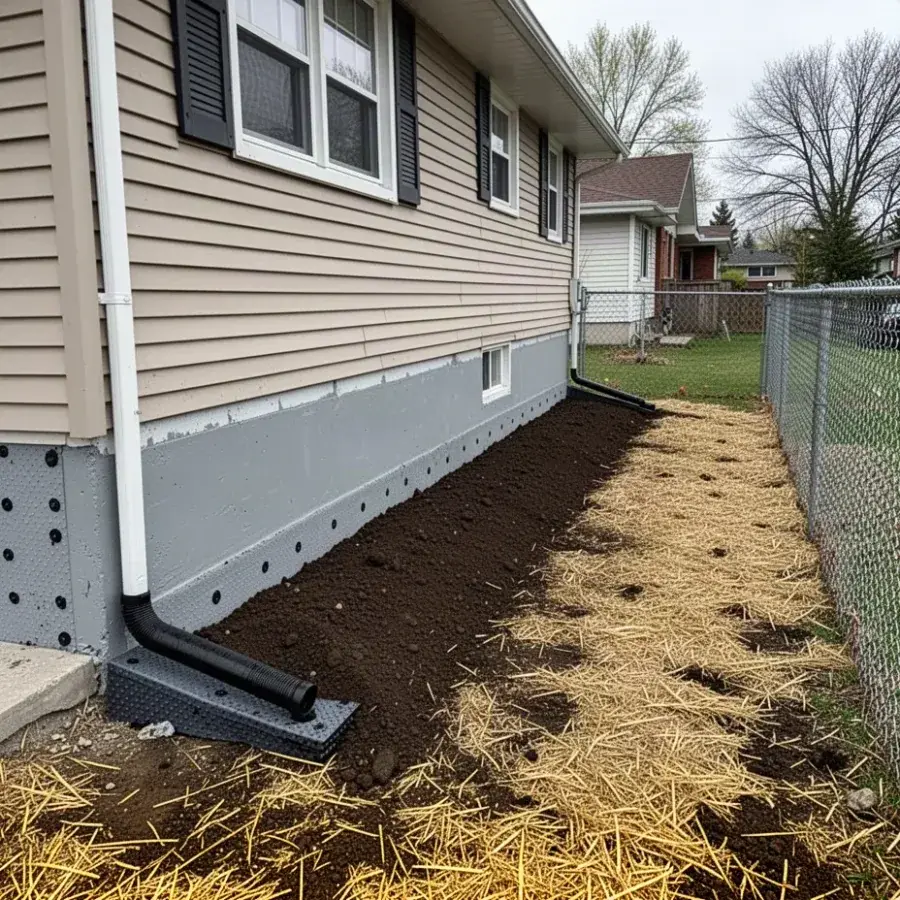
After a primer, the self-adhered membrane goes on in overlapping sheets from footing to just below grade, lapped onto the footing edge.
Dimpled drainage board is fastened over the membrane with a termination strip at the top, giving water a free path down to the weeping tile.
We inspect and replace the weeping tile if needed, using perforated pipe in a filter sock bedded in clear stone and tied into the sump or storm connection.
We backfill with free-draining material, compact in lifts and finish the grade sloping away from the house. Downspouts are extended at least 1.8 m from the wall.
Book a leak assessment and we will find the entry point before recommending a fix.
Exterior foundation waterproofing in Waterloo Region typically runs $200 to $400 per linear foot of wall in 2026. Interior polyurethane crack injection typically costs $500 to $1,000 per crack, and crystalline treatment of a wall section $8 to $15 per sq ft.
Depth drives cost more than anything; a full-height basement dug to 2.4 m costs far more than a crawlspace. Access matters too, since tight side yards, decks, patios and driveways along the wall mean hand digging or removal and replacement.
Landscaping that must be removed and restored, the number of walls involved, and whether the weeping tile needs replacing all add to the price. Cold room porch slab waterproofing usually lands between $3,500 and $9,000, depending on whether the slab can be saved.
We give you a fixed written price after the assessment, plus a written workmanship warranty covering the membrane installation and any crack we inject.
We assess and waterproof foundations throughout Cambridge and the surrounding towns, within roughly a 45 minute drive.
Cold room and cove joint leaks on older homes near the Grand River in Galt and Preston.
Crack injection and exterior membranes on post-war bungalows and newer poured basements.
Below-grade work for houses, rental properties and commercial buildings.
Leaking foundation cracks and porch slabs on homes of every era.
Farmhouse foundations, shop pits and rural basements around New Hamburg and Baden.
Exterior membranes and crack repair on older homes across the city.
Yes, most leaking cracks in poured concrete walls can be sealed from inside with polyurethane injection. The resin is pumped through ports at low pressure, expands on contact with water and fills the crack through the full wall thickness, so the seal holds even with water on the outside.
No. A surface sealer reduces water absorption on driveways and patios, but it cannot hold back water under pressure against a foundation wall or bridge a moving crack.
Usually because the porch slab above it was poured without a membrane, or the membrane has failed and the slab has cracked. Water then runs through the slab and the joint where it meets the house, and the fix is to waterproof the top of the slab or replace it.
A properly installed self-adhered membrane with drainage board and working weeping tile can last for decades. Its life depends most on keeping the drainage clear and the grade sloped away from the house.
Interior crack injection can be done year round. Exterior membranes need dry concrete and suitable temperatures for the primer, so we schedule most excavation work from spring to late fall.
Tell us where the water shows up and when. If the wall itself is failing, our concrete foundations team can advise, and for exterior slabs that only need protection from salt and surface water, see concrete sealing.