Integrally Coloured Flatwork
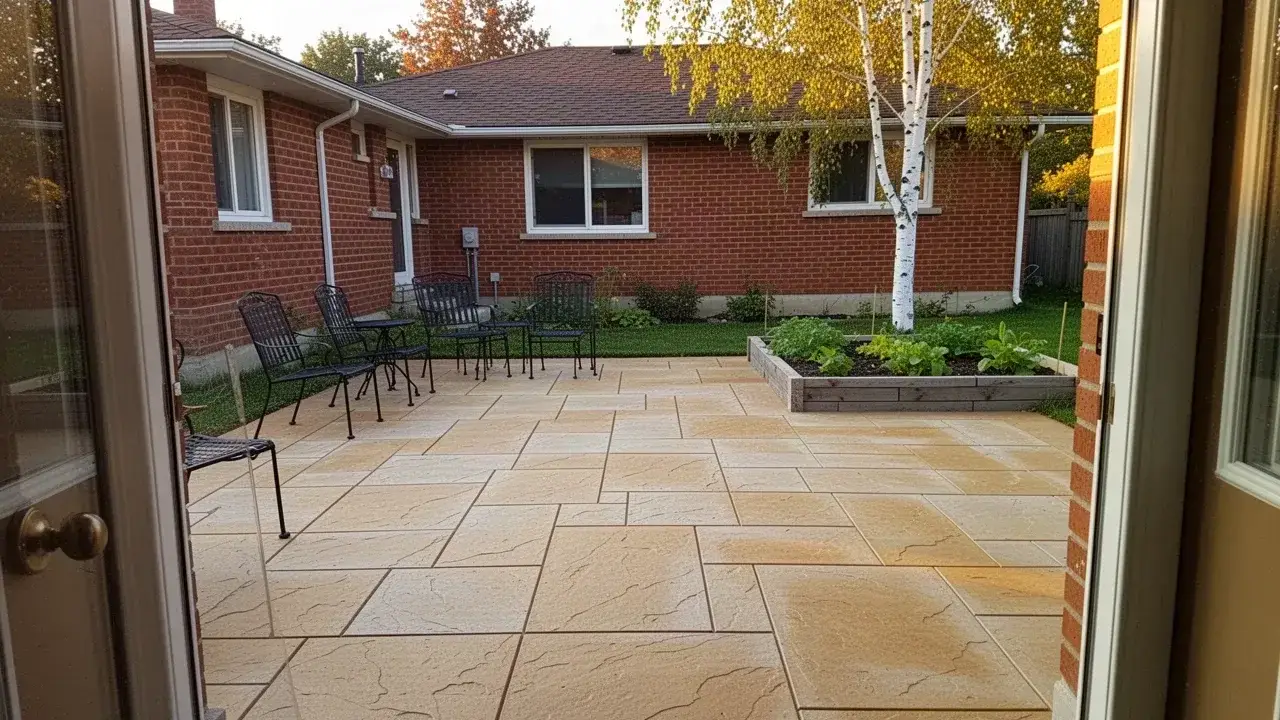
Driveways, patios and walkways tinted through the full depth, from soft greys and buffs to charcoal and terracotta.
Colour and Stain
Sila Concrete Contracting adds colour to concrete two ways: pigment mixed into the concrete before it is poured, or stain applied to concrete that has already cured, whether it is a week old or forty years old. We use both on outdoor driveways, patios and walkways, and on interior basement, shop and retail floors.
Colour is where small mistakes show the most. A splash of water added at the truck, a different cement batch or the wrong curing method can turn an even tan slab into a blotchy one, and we have spent 12+ years and 600+ jobs learning to control those variables.
Because concrete floor installation is our priority service, we often pour and colour interior slabs in one contract, so the floor is built for the finish from the start.
We colour new pours and transform existing slabs, inside and out. These are the jobs we do most often.
Driveways, patios and walkways tinted through the full depth, from soft greys and buffs to charcoal and terracotta.
Dense, vivid surface colour for stamped concrete patios, borders and pool decks, finished with an antiquing release.
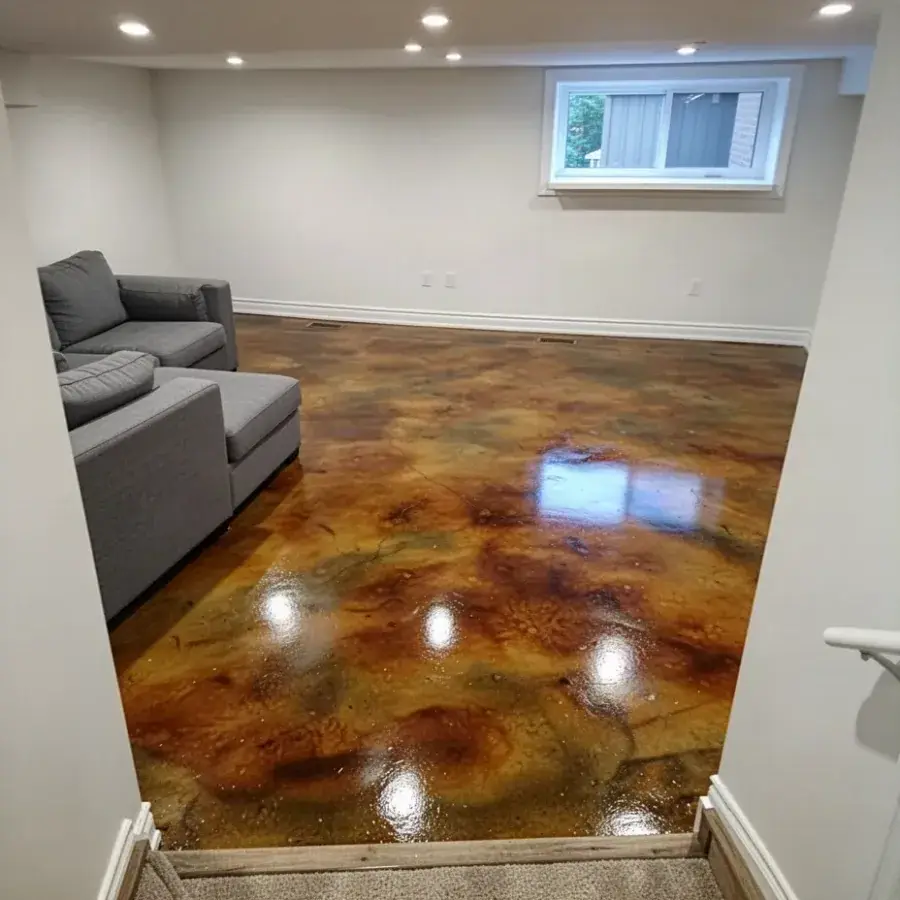
Acid and water-based stains on basement, workshop, loft and retail floors, sealed for daily traffic.
New colour for a sound but dull grey patio or covered porch, without tearing anything out.
Tinted patches and contrasting bands that blend new work into old concrete.
Cleaning, re-colouring and resealing decorative concrete that has gone chalky or patchy.
The core decision is timing. Colour added at the pour needs a new slab and gives solid, durable colour; stain goes on cured concrete, new or old, and gives anything from marbled to even tones.
| Method | New or Existing Slab | Look | Durability | Best Use | Relative Cost |
|---|---|---|---|---|---|
| Integral pigment | New only | Solid, uniform, soft tone | Excellent; runs full depth | Driveways, patios, walkways | $ |
| Dry-shake colour hardener | New only | Solid, vivid | Excellent; harder surface | Stamped work, high-wear areas | $$ |
| Acid (reactive) stain | Existing or new, cured | Mottled, marbled, translucent | Very good; UV-stable | Interior floors, covered patios | $$ |
| Water-based stain | Existing or new, cured | Even, opaque to semi-transparent | Good with sealer | Patched or older slabs, interiors | $ to $$ |
| Dye | Existing or new, cured | Bright, even | Fades in sunlight | Polished interior floors | $$ |
| Tinted sealer | Existing | Light colour wash | Wears with the sealer | Quick refresh only | $ |
Iron-oxide pigment, from suppliers such as Davis Colors or Solomon Colors, is dosed by weight of cement at the ready-mix plant. Because colour runs through the full depth, a chip shows the same tan or charcoal, not grey. It is the best choice for new driveways and patios that see salt.
A dry blend of pigment, cement and fine hard aggregate broadcast onto the fresh slab and trowelled in. It packs more colour into the top few millimetres than integral pigment can, and makes that surface denser and more wear resistant.
Acid stain is a reactive stain: metallic salts in a mild acid react with the lime in cured concrete to form permanent colour. The result is variegated earth tones, browns, ambers and copper greens, that differ slab to slab and will not fade in sunlight.
Water-based acrylic stains offer a much wider palette, including cool greys and blues, and cover patched or older slabs more consistently than acid. Dyes penetrate densified floors and are the usual choice for polished concrete floors, but they are kept indoors because sunlight fades them.
Outside, choose integral colour or colour hardener for anything that gets salted, like driveways and front walks. Stain works well on backyard patios, covered porches and pool surrounds, where salt is rare.
Inside, stains and dyes shine on basements, lofts, retail floors and restaurants, where there is no freeze-thaw and the sealer takes the wear. A dyed and polished slab is one of the lowest-maintenance floors you can own.
There are poor fits too. Stain on a heavily salted driveway lives only in the top layer and scales away with it, and a slab covered in patches will show every repair through the stain.
On a new slab, colour is planned before the trucks are ordered. We order all of the concrete from one plant, one mix design and one cement source, and we finish and cure every section the same way.
On existing concrete, the question is what is blocking the surface. Old sealers, tile glue, paint, oil and grey cement patches all stop stain from reaching the concrete, so we always start with a test patch on your slab.
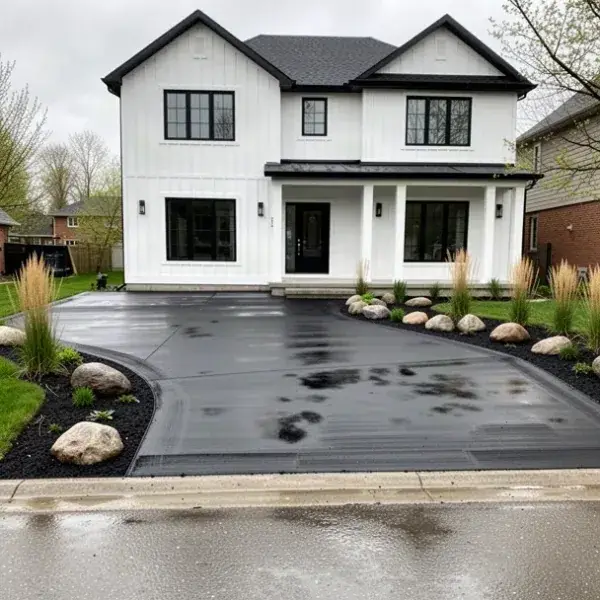
Outside, pull colour from the fixed parts of the house: brick, stone, siding and roof shingles. A warm buff suits red and orange brick, while charcoal and slate greys sit well against modern black-trim exteriors.
Inside, work from the cabinetry, trim and flooring that will meet the slab. Keep in mind that concrete looks darker when wet and richer once sealed, so a dry sample chip can mislead.
We bring sample boards in your shortlist and, for stain, apply a small test patch right on your concrete. Very dark slabs show white salt residue and get hot underfoot in July; very pale ones show tire marks.
The process differs by method. Integral colour and hardener happen on pour day; staining happens on cured concrete.
We confirm the colour code and dosage with the plant and order every truck from the same batch run. Any water adjustment is made at the plant, never with a hose at the chute.
Hardener goes on in two passes and every section gets the same trowelling. We cure with a compatible cure-and-seal rather than plastic sheeting, which leaves dark, mottled marks on coloured concrete.
We check for sealers with a water drop test, look for moisture problems, and stain a small patch so you approve the actual colour on your slab.
Grinding or stripping opens the surface, cracks are filled, and the slab is cleaned until water soaks in evenly.
Stain goes on by sprayer and brush in one or more coats until the colour is built up. Acid stain is then neutralized with an alkaline wash and rinsed until no residue is left.
Once the slab is fully dry, we apply the sealer system chosen for that surface.
Tell us whether the slab is new or existing and where it is, and we will recommend a method and send colour options.
Every coloured or stained surface needs sealer, and the right type depends on whether it lives indoors or out. Our concrete sealing service maintains it afterward.
A breathable acrylic sealer lets moisture escape while deepening the colour, with fine grit added on walkways and steps. Reseal every 2 to 3 years.
A urethane or epoxy system resists hot tires, chemicals and scuffs. Retail and restaurant floors often get a sacrificial floor finish on top that can be buffed and renewed.
Water no longer beads, traffic lanes look duller than the edges, or the colour looks chalky when dry.
Uneven colour almost always comes from something done on site, not from the pigment. Here are the usual causes and how our crews prevent each one.
Chloride accelerators darken and mottle coloured concrete, and water added at the truck lightens it. We use non-chloride accelerators in cold weather and refuse on-site water.
Over-trowelled areas burn darker than the rest. One finisher sets the rhythm for the whole slab.
Curing compound, sealer or unrinsed acid residue blocks stain or makes sealer let go. We test, strip and neutralize before sealing.
Cement repair mortars do not take acid stain like the original slab. We use stain-compatible patching or switch to a water-based system.
Non-breathable sealer over a damp slab turns white and lifts. We moisture test interiors and use breathable sealers outdoors.
Colour that lives in the sealer fades as the sealer wears. We put colour in the concrete itself and keep tinted sealer for touch-ups.
Integral colour typically adds $1.50 to $4 per sq ft over the same slab in plain grey, and colour hardener adds about $2 to $5 per sq ft. Staining existing concrete usually runs $4 to $10 per sq ft including prep and sealer, depending on condition.
| Finish | Typical 2026 Range | What Moves the Price |
|---|---|---|
| Integral colour on new flatwork | Adds $1.50 to $4 per sq ft | Pigment dosage, pale shades needing white cement |
| Colour hardener | Adds $2 to $5 per sq ft | Number of colours, stamped detailing |
| Acid stain, interior floor | $5 to $10 per sq ft | Glue or sealer removal, crack repair, sealer system |
| Water-based stain, existing patio or floor | $4 to $8 per sq ft | Number of colours, patch count, grit sealer |
| Restain and reseal faded surface | $3 to $6 per sq ft | Stripping old sealer, cleaning |
Small coloured pours can also carry a truck minimum or short-load charge, since the plant must clean the drum after a colour batch. We show that as its own line on the quote.
We pour and stain colour throughout the region. As a coloured concrete contractor in Cambridge, we see plenty of tinted patios behind Hespeler and Preston homes, while buyers of older brick homes in Kitchener lean toward warm buffs; see our concrete contractor in Kitchener page.
Stained basement and loft floors are common requests for our concrete contractor in Waterloo crews, and the same goes for character homes when we work as a concrete contractor in Guelph.
Farther out, we colour patios and shop floors as a concrete contractor in Wilmot Township and take on decorative work as a concrete contractor in Brantford.
Integral colour and acid stain hold their colour for the life of the slab because the colour is in the concrete itself. What wears is the sealer and any tinted coating, so the surface can look duller until it is cleaned and resealed.
Usually yes, after a test patch. Old sealers, paint, glue, oil and heavy patching are what stop stain from taking, and we remove what we can by grinding or stripping first.
Yes, over a dry slab. We test moisture first, because vapour coming up through the slab can lift sealer; for a new basement slab, our concrete floor installation crews can pour it ready for stain.
Choose integral colour or colour hardener if the patio will ever see salt or heavy wear. Choose stain if you want a marbled, variegated look on a protected or covered patio.
Yes. Outdoors we use a breathable acrylic, and indoors a urethane or epoxy system, because sealer protects the colour from wear, stains and moisture.
No. Colored concrete has pigment mixed in before it is poured, while stained concrete is coloured after it cures, which is why stain can be used on existing slabs.
Ask for sample boards in your shortlist, photos of past jobs by colour name, or an on-slab stain test. We also quote colour as part of stamped concrete, polished concrete floors, concrete floor installation, concrete sealing and concrete resurfacing projects.